Routing & RPL · Study deck
How Packets Find a Next Hop — Part 2
A routing evidence record should name the traffic scope, route source, selected next hop, packet proof, and changed condition that would reopen the decision.
Packet Pete is your guide for this deck.

After studying this chapter
Learning objectives
You will be able to:
- explain how a router chooses a next hop from forwarding state rather than the full path
- distinguish routing (control plane) from forwarding (data plane), and a default route from a specific one
- apply accept, constrain, retest, and hold decisions to a routing evidence record
- explain why loop limits and neighbor resolution matter when no route is found
Major section
The winning route and its packet evidence
A useful record explains which route wins and how its result was checked.
- The evidence record needs a source, destination prefix, and application path.The local-versus-uplink boundary and expected return path prevent a successful test from covering the wrong traffic scope.
- In this example, /16 compares the first 16 bits, or the first two numbers ( 10.42 ), and /24 compares the first 24 bits, or the first three ( 10.42.18 ).
- For 10.42.18.33, the matching 10.42.18.0/24 route beats 10.42.0.0/16.Removing the /24 leaves the /16 as the next winner, still ahead of the less-specific default route.
- Route snapshots need packet traces and parent state alongside them.The mesh can depend on intermediate devices that sleep or lose link quality, so a table alone cannot establish observed delivery.
Activity 1 · Work it out
✎ Choose the winning route

I want you to explain the winning prefix before trusting the gateway.
On paper, compare 10.42.18.0/24, 10.42.0.0/16, and 0.0.0.0/0 for destination 10.42.18.33. Mark the winner. Remove that route and mark the next winner. Explain both choices.
3 minutes · Pen and paper · Answer: Activity 1
Major section
Accepting, constraining, and reopening a route
Accept, constrain, retest, and hold turn the routing record into a decision.
- Acceptance needs the route and failure behavior to match the traffic.The selected next hop, return path, and loop guard must have evidence for the application path the deployment actually needs.
- Forwarding can be constrained to named prefixes, interfaces, or gateways.Keeping local prefixes local and sending only cloud-bound traffic upstream makes the intended boundary explicit.
- A prefix, metric, parent, or sleep-pattern change requires another review.The earlier packet trace belongs to its tested conditions and cannot automatically establish the changed route’s behavior.
- Undocumented next-hop or device behavior leaves approval unsupported.Missing return-path, loop-limit, memory, or control-message evidence means the design’s fit for constrained devices remains unresolved.
Major section
Practitioner: Build the Routing Evidence Record (continued)
Assuming the visible route order is the selection rule.
- After relay A is removed and the route table updates, at 10 s marker after uses the learned 2001:db8:42::/64 row via relay B on mesh0.
- Retest if the relay, interface, or gateway route changes.
- A prefix is the starting part of an address.
Major section
Practitioner: Build the Routing Evidence Record (continued)
For separate return-path evidence, send a marked response from G to S, record G’s selected route, and check for that response at S.
- The forward captures show delivery to G for these two sends.
- TTL or Hop Limit behavior, unreachable response where relevant, and observed failure when the limit is exhausted.
- Neighbor loss, gateway failover, mesh parent change, stale-route handling, and retest trigger.
Major section
Practitioner: Build the Routing Evidence Record (continued)
Trusting a route that only works while one preferred neighbor is healthy.
- Route snapshot, neighbor or parent state, packet trace, diagnostic response, and change owner.
- Both routes match 10.42.18.33, so 10.42.18.0/24 wins over 10.42.0.0/16 because it matches more of the address.
- ConstrainKeep local prefixes local, route only cloud-bound traffic upstream, or limit a route to a named interface or gateway.
Major section
From loop guard to delivery or drop
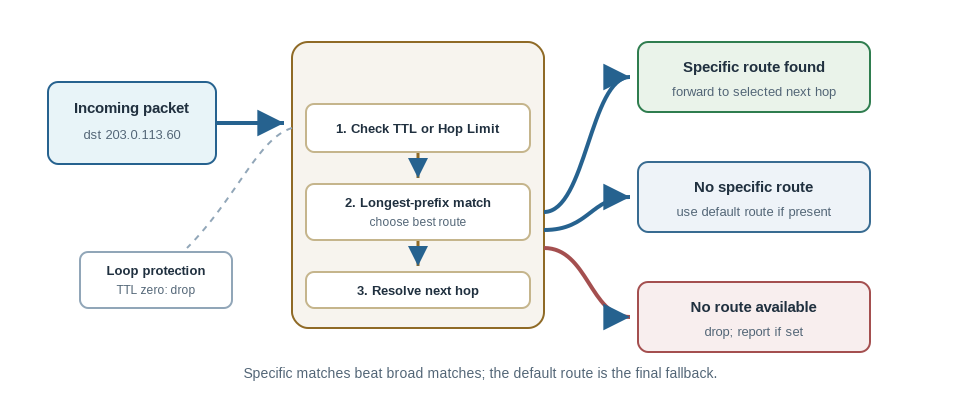
Trace the forwarding checks from the loop guard through route lookup to delivery or drop.
- The first guard uses TTL or Hop Limit to bound packet circulation.A packet whose limit is exhausted is dropped before it can keep circulating through the same forwarding loop.
- The destination lookup selects the most specific usable route.The diagram includes the default-route fallback, which matters only when no more specific matching entry can supply the next step.
- Neighbor resolution supplies the next local delivery address when needed.ARP for IPv4 Ethernet or Neighbor Discovery for IPv6 links can precede transmission of the outgoing link-layer frame.
- The no-route branch ends with a drop.A missing usable match and missing fallback leave no justified next hop, so the packet is not forwarded blindly.
Major section
Loop limits and local delivery addresses
Loop limits and neighbor resolution protect different parts of the forwarding step.
- Each router reduces IPv4 TTL or IPv6 Hop Limit.The decreasing value limits how far a packet can circulate if forwarding state accidentally sends it around a loop.
- An exhausted loop limit stops further packet forwarding.Dropping at zero bounds the failure instead of allowing a bad path to consume forwarding effort indefinitely.
- ARP or Neighbor Discovery can resolve the next local delivery address.This step supplies link-layer addressing when required; it does not choose a complete end-to-end path for the application.
- The outgoing frame is new while the IP destination normally stays unchanged.Each hop must create a new local envelope for the selected neighbor while preserving the packet’s intended destination network.
Major section
Parent choice in a constrained mesh
RPL fits constrained meshes by organizing forwarding around selected parents.
- Battery operation and lossy links can change the usable parent.Sleeping neighbors, limited memory, and changing link quality make stable enterprise-network assumptions unsuitable for some constrained devices.
- RPL uses a destination-oriented directed acyclic graph near a border router.This structure can organize constrained nodes around selected parents rather than requiring each sensor to maintain a full network map.
- An objective function can guide the parent choice.Nodes maintain enough state to forward traffic, but the selected parent still needs evidence under the deployment’s actual link conditions.
- The review needs link quality, repair cost, and return-path evidence.Control-message budget and repair behavior determine whether a parent change fits the constrained devices after the preferred route fails.
Activity 2 · Draw it
✎ Trace a changed parent
I want you to sketch what changes when the preferred parent disappears.
Draw a sensor, its preferred parent, an alternative parent, and the gateway. Cross out the preferred parent. Mark the new next hop and list the route, packet, and return-path evidence needed to review recovery.
4 minutes · Pen and paper · Answer: Activity 2
Major section
The mesh, site, and provider boundaries
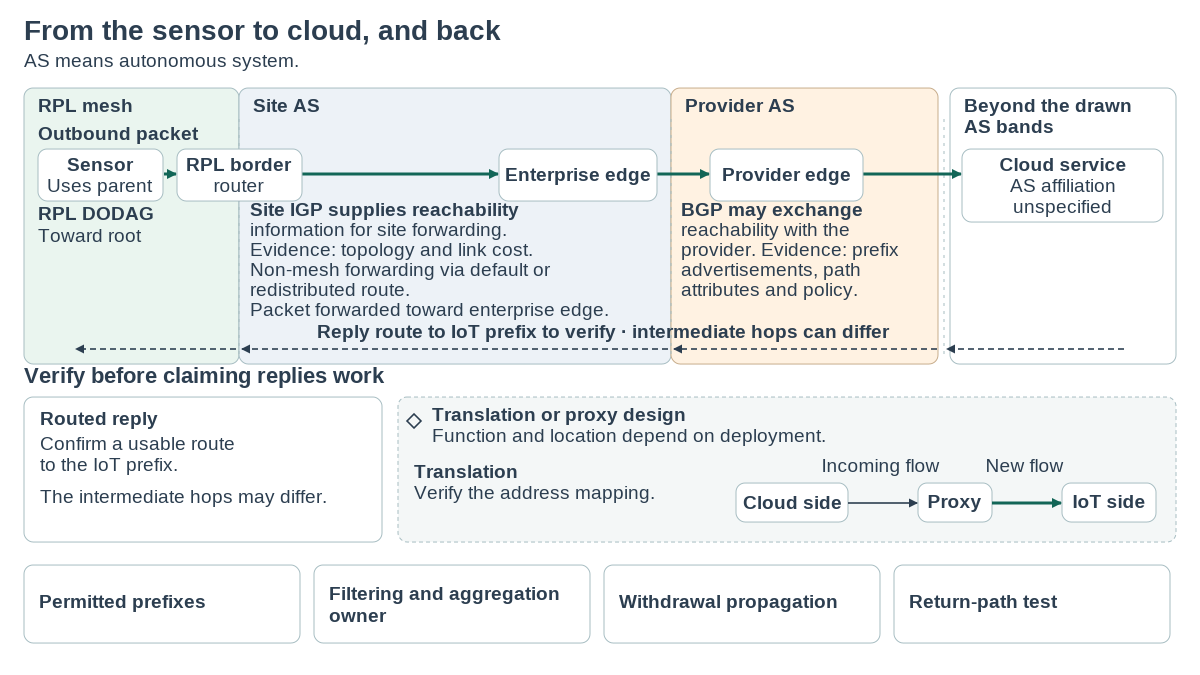
The constrained mesh hands traffic to site routing before an external edge applies provider policy.
- The RPL border router connects the mesh to an explicit site route.It terminates the constrained topology and sends non-mesh traffic toward a default or redistributed route under the reviewed boundary rules.
- An IGP carries reachability and path-cost information within an administrative domain.The site network can use this information to move the packet toward its enterprise edge without placing that responsibility on each sensor.
- BGP applies route policy between autonomous systems at a controlled edge.Provider-facing policy belongs at the managed network boundary and needs prefix advertisements, filtering, and path-selection evidence.
- The return path needs a route to the IoT prefix.An explicit translation and proxy design can define another arrangement, but a working outbound ping alone cannot establish inbound reachability.
Major section
Under the Hood: Forwarding, Loop Limits, and Why RPL Appears (continued)
The takeaway is not that every IoT network needs RPL.
- Neighbor ResolutionLocal delivery may need ARP for IPv4 Ethernet or Neighbor Discovery for IPv6 links before the next frame can be sent.
- No RouteIf no matching route and no default route exist, the router drops the packet and may report the destination as unreachable.
- Star topologies, Ethernet gateways, and industrial networks may use other routing arrangements.
Major section
Under the Hood: Forwarding, Loop Limits, and Why RPL Appears (continued)
A stable enterprise routing design may assume more memory, bandwidth, and neighbor stability than those devices can offer.
- For example, a rule that prefers more reliable links can choose a candidate with better measured delivery if that candidate also meets the graph and policy checks.
- Nodes maintain enough state to forward traffic without requiring every constrained node to know a full network map.
- The point is that low-power mesh routing needs evidence about parent choice, link quality, control-message budget, repair behavior, and return paths, not just a generic statement that routing exists.
Major section
IGP And BGP: The Gateway Boundary
It sends non-mesh traffic to a default or redistributed route.
- A network under one administration is an autonomous system.
- An interior gateway protocol (IGP) such as OSPF shares which destinations can be reached and their path costs within one system: BGP shares reachability between systems.
- The site IGP carries the packet to the enterprise edge.
Major section
IGP And BGP: The Gateway Boundary (continued)
Neither term means “the Internet,” and small endpoints do not all need these protocols.
- There, a router may use BGP with a provider on the way to a cloud service.
- The return path needs valid reachability to the sensor and may cross different network boundaries.
- It needs a route to the IoT prefix, or a documented translation and proxy design.
Major section
Summary
Reliable routing joins the local forwarding rule to evidence from changed conditions.
- Destination lookup identifies the next step rather than a complete global path.The sensor, gateway, and ISP router can each use local forwarding state to move the cloud-bound packet toward its destination.
- Longest-prefix match keeps specific routes ahead of the default fallback.The chapter’s /24 wins over its matching /16 for 10.42.18.33, while the default remains the least-specific option.
- Loop limits and no-route drops can bound failed forwarding.A packet is dropped when its limit expires or no usable route exists, rather than circulating or advancing by guesswork.
- Mesh evidence must explain parent selection, repairs, and the return path.Sleeping nodes and changing links can invalidate a previously usable next hop, so a single successful message cannot establish recovery.
Deck summary
Key takeaways
Trust the path only when its forwarding choices and review triggers are visible.
- Route tables show intended choices, while packet traces show observed results.Keeping snapshots, parent state, timing, delivery, and loss together makes a failed sensor path diagnosable after a route change.
- A working default route does not establish the return path.The remote network still needs reachability to the IoT prefix or the explicitly documented translation and proxy arrangement.
- Changed neighbors and sleeping devices can invalidate an earlier decision.The next packet can encounter an unavailable preferred parent even after a previous message reached the gateway successfully.
- Traffic or routing changes require the evidence record to be reopened.Prefixes, gateway rules, metrics, parents, border routers, and sleep patterns define concrete reasons to retest the previously observed path.
Retrieval practice
Recall check 1 of 4
Packet Pete says: answer from memory, then check your reasoning.
Q1A gateway has routes for 10.0.0.0/8, 10.42.0.0/16, 10.42.18.0/24, and 0.0.0.0/0. Which route should it use for a packet destined to 10.42.18.33?
Show answer
Answer: C The routing evidence record should make the selected route visible.
Retrieval practice
Recall check 2 of 4
Packet Pete says: answer from memory, then check your reasoning.
Q2Why do constrained IoT meshes often need routing evidence beyond a normal gateway route table?
Show answer
Answer: D Under the hood, IoT routing evidence must connect forwarding mechanics with constrained-network behavior: parent choice, route freshness, loop limits, and failure recovery.
Retrieval practice
Recall check 3 of 4
Packet Pete says: answer from memory, then check your reasoning.
Q3Where should a low-power sensor's RPL forwarding normally hand off toward an external cloud service?
Show answer
Answer: C The border router is the evidence boundary between the RPL domain and site routing.
Retrieval practice
Recall check 4 of 4
Packet Pete says: answer from memory, then check your reasoning.
Q4A router has a route entry, but cannot resolve the selected next hop. What is the safe forwarding review?
Show answer
Answer: D A forwarding decision needs route selection, usable neighbor resolution, loop protection, and a defined failure outcome.
Print reference
Answers
Answer key.
- C · The routing evidence record should make the selected route visible.
- D · Under the hood, IoT routing evidence must connect forwarding mechanics with constrained-network behavior: parent choice, route freshness, loop limits, and failure recovery.
- C · The border router is the evidence boundary between the RPL domain and site routing.
- D · A forwarding decision needs route selection, usable neighbor resolution, loop protection, and a defined failure outcome.
Print reference
Activity 1 answer
Model answer.
Work it out: 10.42.18.0/24 wins because it is the longest matching prefix. After its removal, 10.42.0.0/16 wins. The default 0.0.0.0/0 remains less specific than either route.
Print reference
Activity 2 answer
Model answer.
Draw it: The sketch sends the sensor toward an available alternative parent and onward to the gateway. Keep parent and route state before and after the change, packet delivery or loss and timing, loop-limit behavior, and a checked return path.