Mobile Robotics · Study deck
Mobile Robot Kinematics and the Perception-Action Loop — Part 2
The horizontal projection is ucosθ and the vertical projection is usinθ.
Motor Max is your guide for this deck.
After studying this chapter
Learning objectives
You will be able to:
- Trace perception, decision-making, control, and action around a robot's autonomy loop
- Classify robot sensors as proprioceptive or exteroceptive and as passive or active
- Distinguish holonomic, non-holonomic, and redundant actuation from degrees of freedom
- Derive differential-drive forward and inverse kinematics in body and world frames
Major section
Body motion in world coordinates
Rotating body velocity into the world frame preserves the no-sideways-motion constraint.
- Heading determines the world components of forward body velocity.The chapter gives world x velocity as u cos θ and world y velocity as u sin θ.
- The two world components depend on the same speed and heading.Changing coordinate frames describes the existing motion without adding an independent lateral actuator to the differential drive.
- Arbitrary independent world-velocity commands can violate the mechanism’s constraint.At θ=0, 0.40 m/s and zero satisfy 0.40 sin 0=0 cos 0; the no-sideways constraint still applies after inverse coordinate rotation.
- A feasible path needs its tangent aligned with the robot’s heading.The planner constructs a direction the wheels can follow, rather than using pose error to demand an impossible sideways slide.
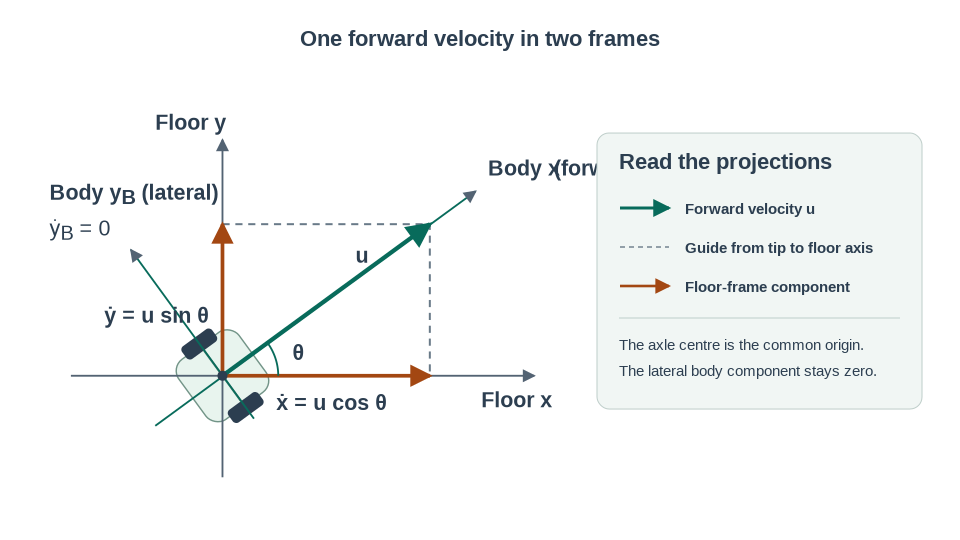
I am expressing the floor robot’s forward motion in world coordinates. I rotate by its heading while keeping the same no-sideways-motion constraint, so the two world components remain linked.
Activity 1 · Predict
✎ Rotate the forward direction
I want you to predict the world direction before rotating the velocity.
A differential-drive robot faces 90 degrees counterclockwise from positive world x. Choose whether positive world x or positive world y points straight ahead. Check the no-sideways constraint.
2 minutes · Pen and paper · Answer: Activity 1
Major section
Goal headings and Bezier curvature (1/2)
A Bezier path can align endpoint tangents with the current and goal headings.
- Current and goal positions define the Bezier curve’s endpoints.A goal pose names position and heading; p1/p4 locate endpoints before inner control points align current and goal headings.
- Inner control points can align endpoint tangents with the chosen headings.The path construction can address the no-sideways-motion constraint by connecting endpoint direction with current and target orientation.
Major section
Goal headings and Bezier curvature (2/2)
- Path curvature determines the required turning schedule.The turn rate depends on both path curvature and the chosen forward speed; wheel and acceleration limits still need checking.
- A smooth curve still needs checks against physical limits.Curvature, wheel speed, obstacle clearance, and acceleration can rule out a control-point choice even when the endpoint headings match.
Major section
State and control inputs across platforms
Different platforms connect state and control inputs through different physical constraints.
- A differential drive has 3 pose DOF and 2 controllable DOF.Forward and angular velocity control the floor robot, while its instantaneous lateral velocity remains constrained to zero.
- A bicycle has 3 pose DOF with speed and steering inputs.Its turning rate is coupled to forward motion through steering angle and wheelbase, requiring its own motion model.
- The chapter’s quadrotor model has 6 DOF and 4 control inputs.The model uses one body-force and three body-moment inputs to control position plus roll, pitch, and yaw.
- Quadrotor translation and attitude are dynamically coupled.The chapter’s different platform equations mean a differential-drive controller cannot be reused as though the mechanisms had identical constraints.
Major section
Under the Hood: Rotate Frames, Respect Constraints, Plan Curvature (continued)
The body lateral axis yB points a quarter-turn left of xB, and the velocity along it is zero.
- The inverse rotation gives u=x˙cosθ+y˙sinθ and ω=θ˙, but it does not erase the mechanism's constraint.
- Substitution gives 0.40sin0=0cos0, so the request satisfies the no-sideways-motion constraint.
- Rotate back to recover the body forward speed.
Major section
Reveal the answer
Positive world y velocity: At 90∘, the no-sideways-motion constraint becomes x˙sin90∘=y˙cos90∘, or x˙⋅1=y˙⋅0, so x˙=0.
- The body-frame forward speed is u=x˙⋅0+y˙⋅1=y˙.
- Bezier curvature and wheel limits].
Major section
Reveal the answer (continued)
In the heading-zero example above, positive world x was body-forward.
- With cos60∘=0.5 and sin60∘=3/2, the departure offsets are 0.25 m and 0.433013 m.
- These endpoint directions do not establish obstacle clearance or actuator feasibility.
- The tangent heading is ψ=atan2(y′,x′).
Major section
Reveal the answer (continued)
The curve B(t∣p1,p2,p3,p4) now leaves along the current orientation and arrives along the target orientation.
- Its curvature and a chosen forward-speed schedule together supply the turn-rate schedule.
- Differentiating with respect to t and grouping the terms by consecutive point differences gives.
- Dividing the heading change by the distance change gives.
Major section
Reveal the answer (continued)
Signed curvature κ measures how much the tangent heading ψ changes per metre travelled along the curve.
- Differentiating this angle gives dψ/dt=(x′y′′−y′x′′)/(x′2+y′2).
- Arc length s increases at ds/dt=x′2+y′2.
- This formula requires a nonzero tangent (x′,y′).
Major section
Reveal the answer (continued)
At t=0.5, the derivatives are x′=1, y′=2t=1, x′′=0 and y′′=2.
- At forward speed u=ds/d(time), the yaw rate is ω=uκ.
- The curvature is (1⋅2−1⋅0)/(12+12)3/2≈0.707 m−1.
- The three body moments change its attitude.
Major section
Reveal the answer (continued)
Substitution in the Bernstein form gives x(t)=(1−t)2t+2(1−t)t2+t3=t and y(t)=(1−t)t2+t3=t2.
- The right wheel exceeds an illustrative 8 rad/s cap.
- In the Bernstein formula, the extra 1/3 adds 3(1−t)2t(1/3)=t(1−t)2 to the x coordinate.
- Differential-drive and bicycle models have non-holonomic no-side-slip constraints.
Major section
Reveal the answer (continued)
After 2/3 through t=1, the curvature is negative and the left wheel exceeds the cap.
- The derivatives are x′=2−4t+3t2, x′′=−4+6t, y′=2t and y′′=2.
- The numerator of the curvature is (2−4t+3t2)2−(2t)(−4+6t)=4−6t2.
- Their equations differ because their mechanisms differ.
Major section
Reveal the answer (continued)
The quadrotor is underactuated: its four independent inputs cannot command all six pose coordinates independently at an instant.
- With zero curvature, both wheels are already at the cap, u/r=0.40/0.05=8 rad/s.
- From t=0 up to but excluding 2/3, the curvature is positive and the right wheel exceeds the cap.
- Reusing a differential-drive controller on a bicycle or quadrotor is a model mismatch.
Major section
Reveal the answer (continued)
Since tan30∘=1/3, the yaw rate is θ˙=(1 m/s)(1/3)/(0.5 m)=2/3 rad/s≈1.15 rad/s.
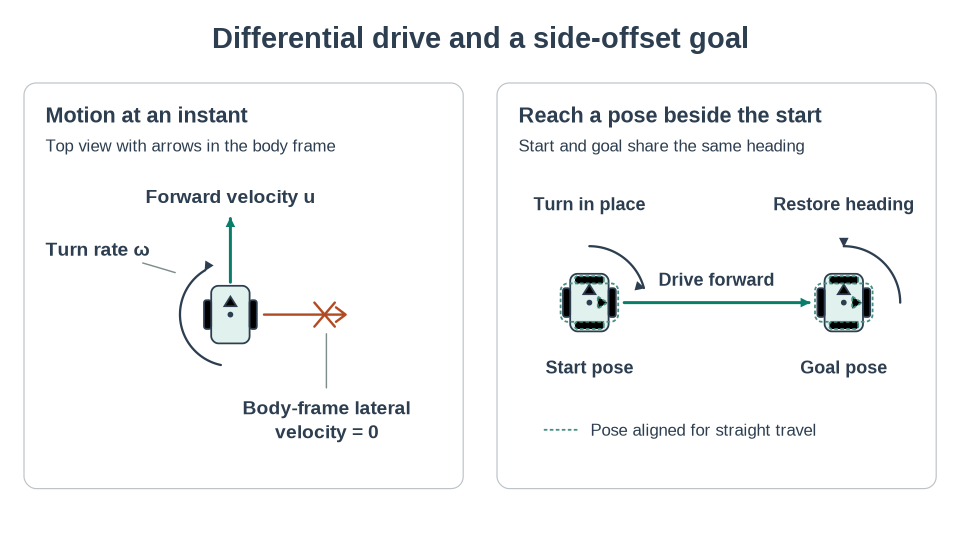
- The strip shows an arm and marks an extra motor with a cross.
- It warns against assuming that a plan adds a motor to the machine.
- For a two-wheel robot, the plan must respect the limit on sideways motion.
Major section
Reveal the answer (continued)
A path is a proposed way to move; it does not change the controls already fitted to the robot.
- The green arrow follows the base’s heading, the curved arrow shows rotation about its centre, and the crossed arrow marks zero sideways velocity in the body frame.
- The dashed outline at the start shows the base facing the goal.
- The dashed outline at the goal shows the base on arrival, still facing along the straight segment.
Major section
Summary
Close the loop around the motion that the mechanism can actually attempt.
- Sensors and estimation supply the state for the next action.The controller needs observations of both the robot and its environment before selecting motion that the mechanism can attempt.
- Forward and inverse kinematics connect wheel rates with feasible body motion.Forward kinematics predicts travel, while inverse kinematics converts requested forward speed and turning into individual wheel commands.
- Closed-loop following measures deviations and recomputes commands.Wheel slip, sensor error, and moving obstacles become evidence for the next command rather than invisible departures from precomputed travel.
- The motion contract needs command limits and a stale-perception response.The chapter also records the state estimate, update rate, and saturation behavior because feedback cannot guarantee a perfect estimate or feasible replanning.
Major section
Summary (continued)
Closed-loop following repeatedly measures and replans because kinematics alone cannot remove disturbance or uncertainty.
- The perception-action loop connects sensing, estimation, decision-making, and physical action.
- Proprioceptive/exteroceptive and passive/active are separate sensor-classification axes.
- A differential drive has three planar pose coordinates but only two independently controllable instantaneous motions.
Deck summary
Key takeaways
An honest motion contract connects sensing, geometry, constraints, and feedback.
- Sensor role and energy mechanism answer different classification questions.The encoder and ultrasonic ranger can both be active while measuring the robot and the environment respectively.
- Pose coordinates do not guarantee equally many independent motion commands.A differential drive needs three coordinates to describe its floor pose but cannot command instantaneous sideways travel.
- Wheel-speed signs can check the requested travel direction.In the chapter’s example, 10.4 rad/s on the right and 5.6 rad/s on the left agree with a left curve.
- Feedback reveals model errors but cannot remove every uncertainty.The estimated state can remain imperfect, and a replanned path still needs feasibility checks against motion and obstacle constraints.
Retrieval practice
Recall check
Motor Max says: answer from memory, then check your reasoning.
Q1Why can a cubic Bezier path help a differential-drive robot reach a goal pose when an unconstrained Cartesian pose-error command may fail?
Show answer
Answer: C A feasible path works with the mechanism: its tangent follows the robot heading, after which inverse kinematics can turn the path velocity into wheel commands.
Print reference
Answers
Answer key.
- C · A feasible path works with the mechanism: its tangent follows the robot heading, after which inverse kinematics can turn the path velocity into wheel commands.
Print reference
Activity 1 answer
Model answer.
Predict: Positive world y points straight ahead. At 90 degrees the constraint requires world x velocity to be zero; body forward speed equals world y velocity.