IoT Value and Product Strategy · Study deck
Device Evolution: Wireless and Classification
A phone can switch a lamp on, yet the lamp may make no decision of its own.
Ada is your guide for this deck.
After studying this chapter
Learning objectives
You will be able to:
- Explain: Wi-Fi sits in the middle, with plenty of bandwidth and an appetite for power that rules out years on a battery.
- Explain: For Engineers: The combination of low-power computing (Cortex-M) and low-power wireless (BLE, LoRa, NB-IoT) defines the technical foundation.
- Explain: Why It's Wrong: App control can establish a basic connected IoT service, but it does not prove learning, prediction, or optimisation.
- Explain: Each paradigm shift represents not just more devices, but a fundamental change in principles, technology, systems, and applications.
Major section
Start With the Decision
A phone can switch a lamp on, yet the lamp may make no decision of its own.
- Radio access, remote control, and local intelligence must be classified separately.
Major section
Wireless Paradigm Shift
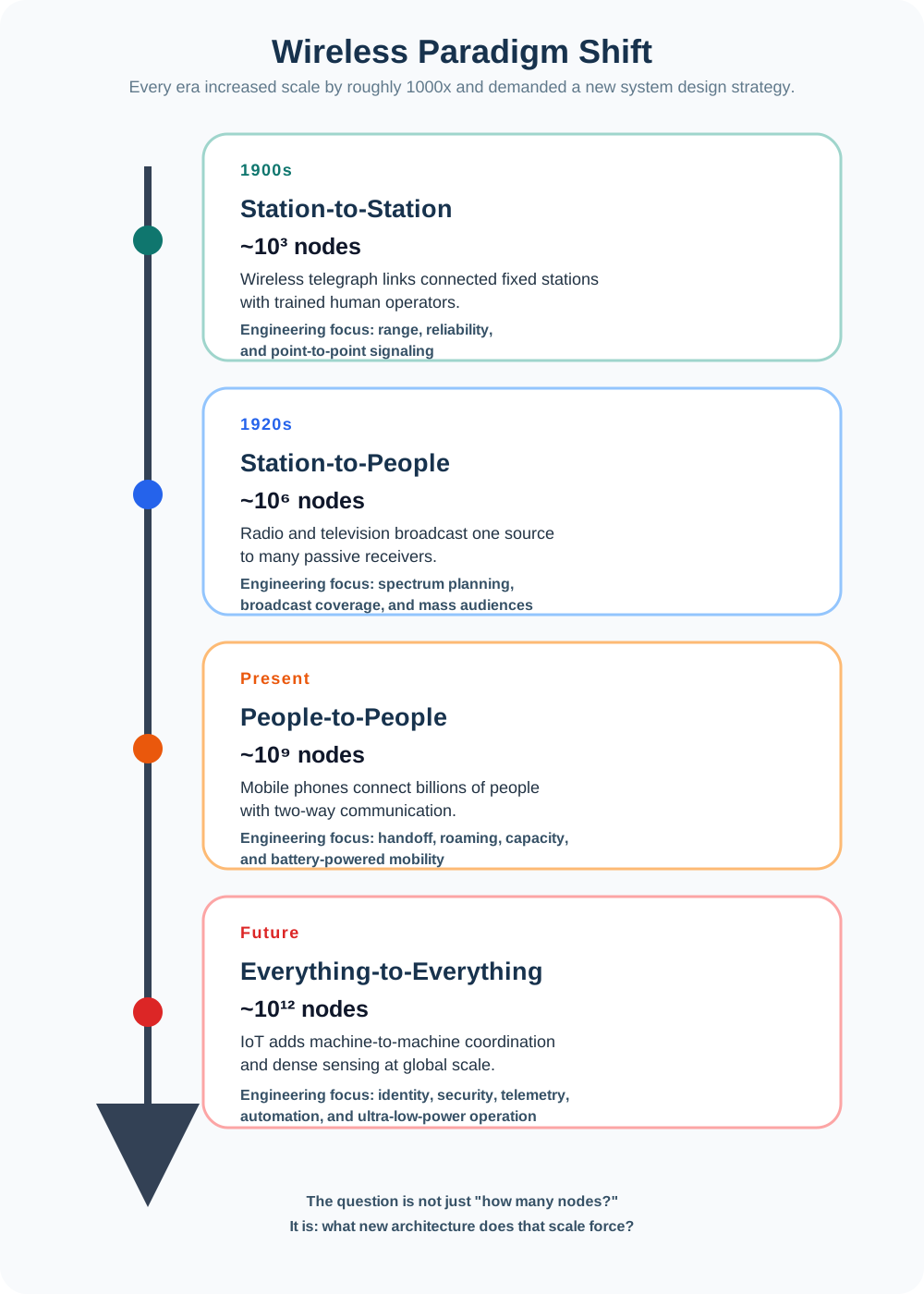
The last band changes the subject again.
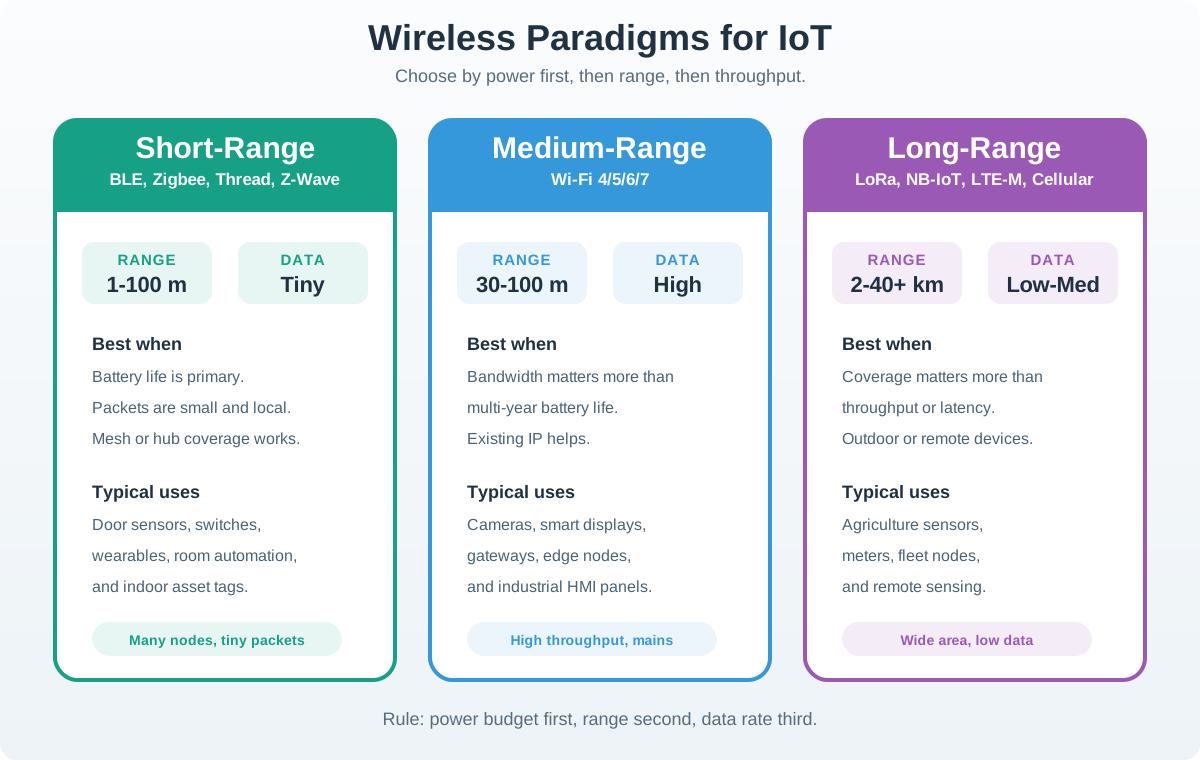
- The further a link reaches, the less it carries.
- Each paradigm shift represents not just more devices, but a fundamental change in principles, technology, systems, and applications.
Major section
Wireless Paradigm Shift (continued)
Wi-Fi sits in the middle, with plenty of bandwidth and an appetite for power that rules out years on a battery.
- For Engineers: The combination of low-power computing (Cortex-M) and low-power wireless (BLE, LoRa, NB-IoT) defines the technical foundation.
- Paradigms need design: addressing and security shift with scale; continuous sensor streams need edge processing and battery or harvested power.
Major section
Practical Takeaways
For Business Leaders: Connectivity alone does not justify subscription revenue.
- A hub with Wi-Fi, Z-Wave control, Cortex-M4, and cloud status but no automation or learning is a connected device.
- Why It's Wrong: App control can establish a basic connected IoT service, but it does not prove learning, prediction, or optimisation.
Deck summary
Key takeaways
A phone can switch a lamp on, yet the lamp may make no decision of its own.
- The last band changes the subject again.
- Wi-Fi sits in the middle, with plenty of bandwidth and an appetite for power that rules out years on a battery.
- For Business Leaders: Connectivity alone does not justify subscription revenue.
Retrieval practice
Recall check 1 of 6

Ada says: answer from memory, then check your reasoning.
Q1A smart thermostat learns your schedule, adjusts temperature before you arrive home, and integrates with weather forecasts to optimize energy use. Using the classification decision tree, what category is this device?
Show answer
Answer: D The thermostat learns schedules and integrates forecasts to act before occupants arrive, demonstrating an adaptive IoT service beyond simple remote control.
Retrieval practice
Recall check 2 of 6

Ada says: answer from memory, then check your reasoning.
Q2The ARM Cortex-M processor (2004) and Bluetooth Low Energy (2010/2013) are considered the two key enabling technologies for practical IoT. Why is low power consumption critical for both?
Show answer
Answer: B Cortex-M reduces sleeping compute draw, while BLE reduces radio energy.
Retrieval practice
Recall check 3 of 6

Ada says: answer from memory, then check your reasoning.
Q3A fitness tracker counts steps, measures heart rate, and syncs data to a smartphone app. It also detects that you consistently walk 4,000 steps before noon and sends a gentle reminder at 11:45 AM if you're below 3,000. Which category does this device represent?
Show answer
Answer: A Correct answer is A.
Retrieval practice
Recall check 4 of 6

Ada says: answer from memory, then check your reasoning.
Q4What kind of embedded product runs local logic without an internet path or remote service?
Show answer
Answer: B An embedded device runs local purpose-built logic but has no internet path, remote service, or cross-product coordination.
Retrieval practice
Recall check 5 of 6

Ada says: answer from memory, then check your reasoning.
Q5A company markets a WiFi-connected thermostat as a "smart IoT thermostat." It allows users to set temperature schedules via a phone app and check current temperature remotely. However, it cannot learn user preferences, adjust to occupancy patterns, or integrate with other home devices. How should this device be classified?
Show answer
Answer: B The thermostat is a physical thing with computation and an internet path, so it qualifies as IoT.
Retrieval practice
Recall check 6 of 6

Ada says: answer from memory, then check your reasoning.
Q6In 2004, ARM released the Cortex-M processor family. Why was this specific development a critical enabler for the IoT era, rather than simply an incremental improvement in embedded computing?
Show answer
Answer: C Before Cortex-M, designers faced a choice: 8-bit processors with low power but limited capability, or 32-bit processors with higher capability but excessive power consumption.
Print reference
Answers 1 of 2
Answer key.
- D · The thermostat learns schedules and integrates forecasts to act before occupants arrive, demonstrating an adaptive IoT service beyond simple remote control.
- B · Cortex-M reduces sleeping compute draw, while BLE reduces radio energy.
- A · Correct answer is A.
- B · An embedded device runs local purpose-built logic but has no internet path, remote service, or cross-product coordination.
- B · The thermostat is a physical thing with computation and an internet path, so it qualifies as IoT.
Print reference
Answers 2 of 2
Answer key.
- C · Before Cortex-M, designers faced a choice: 8-bit processors with low power but limited capability, or 32-bit processors with higher capability but excessive power consumption.