Wireless Sensor Networks · Study deck
Node Behaviour: Contradictions and Review
A node can send valid-looking values that clash with its neighbours.
Packet Pete is your guide for this deck.
After studying this chapter
Learning objectives
You will be able to:
- Explain: If a node decision depends on calibration, time, state, route, queue, key, battery, enclosure, or owner, that dependency should appear in the evidence record with a known limit and retest trigger.
- Explain: The goal is to preserve enough evidence that another reviewer can see why the node is acceptable, what it cannot prove, and who owns the next action when evidence weakens.
- Explain: The useful first choice is its field role: what it senses, what it stores, when it speaks, what it may relay, and how long it must work alone.
- Distinguish missing evidence from contradictory evidence.
Major section
Start With the Decision · Plausible but Contradictory
A node can send valid-looking values that clash with its neighbours.
- Scenario: a storage area has several related condition readings.
- One node reports a value that is possible by itself, but it repeatedly contradicts nearby observations and the expected process state.
- Observation: The node still sends complete messages.
- Consistency fails repeatedly.
Major section
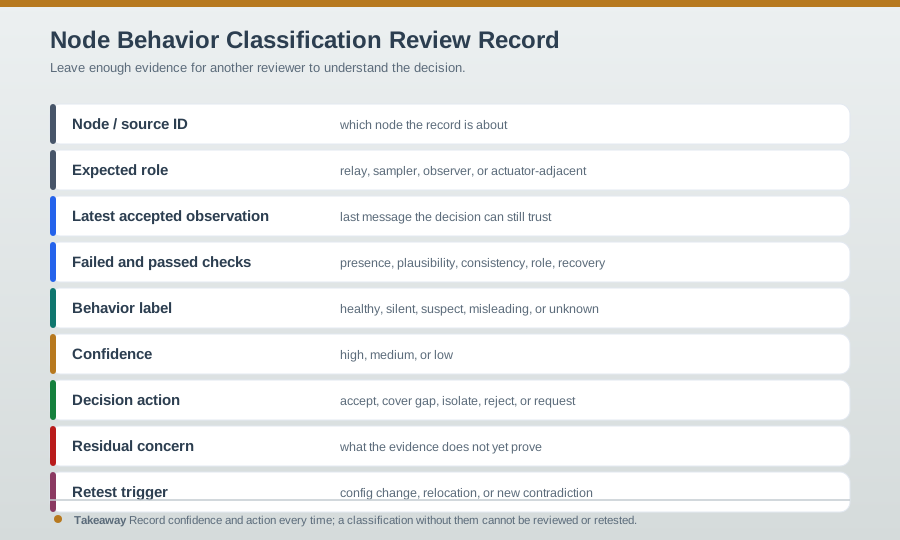
Worked Review: Mixed Missing Evidence · Review Record
Scenario: a gateway notices that one node's current reading is missing.
- The node's previous reading was accepted, but the expected message did not arrive during the current review window.
- If nearby nodes are also missing, the label may stay silent or move into limited-capability recovery review.
Major section
Sensor Node Characteristics
Firmware is the code that runs on a device.
- The useful first choice is its field role: what it senses, what it stores, when it speaks, what it may relay, and how long it must work alone.
- A small node can save cost and power, but it may hide faults or lose useful proof.
- Role changes deserve explicit review.
Major section
Sensor Node Characteristics (continued)
Extra logs can aid repair, but they use store, energy, and air time.
- A board list does not prove the node will stay fit in the field.
- It must sense, process, store, communicate, sleep, wake, diagnose itself, and survive service conditions well enough for the monitoring claim it supports.
- A part list is only a starting point.
Major section
Sensor Node Characteristics (continued)
Firmware hides missing, stale, filtered, or replayed data as if it were fresh evidence.
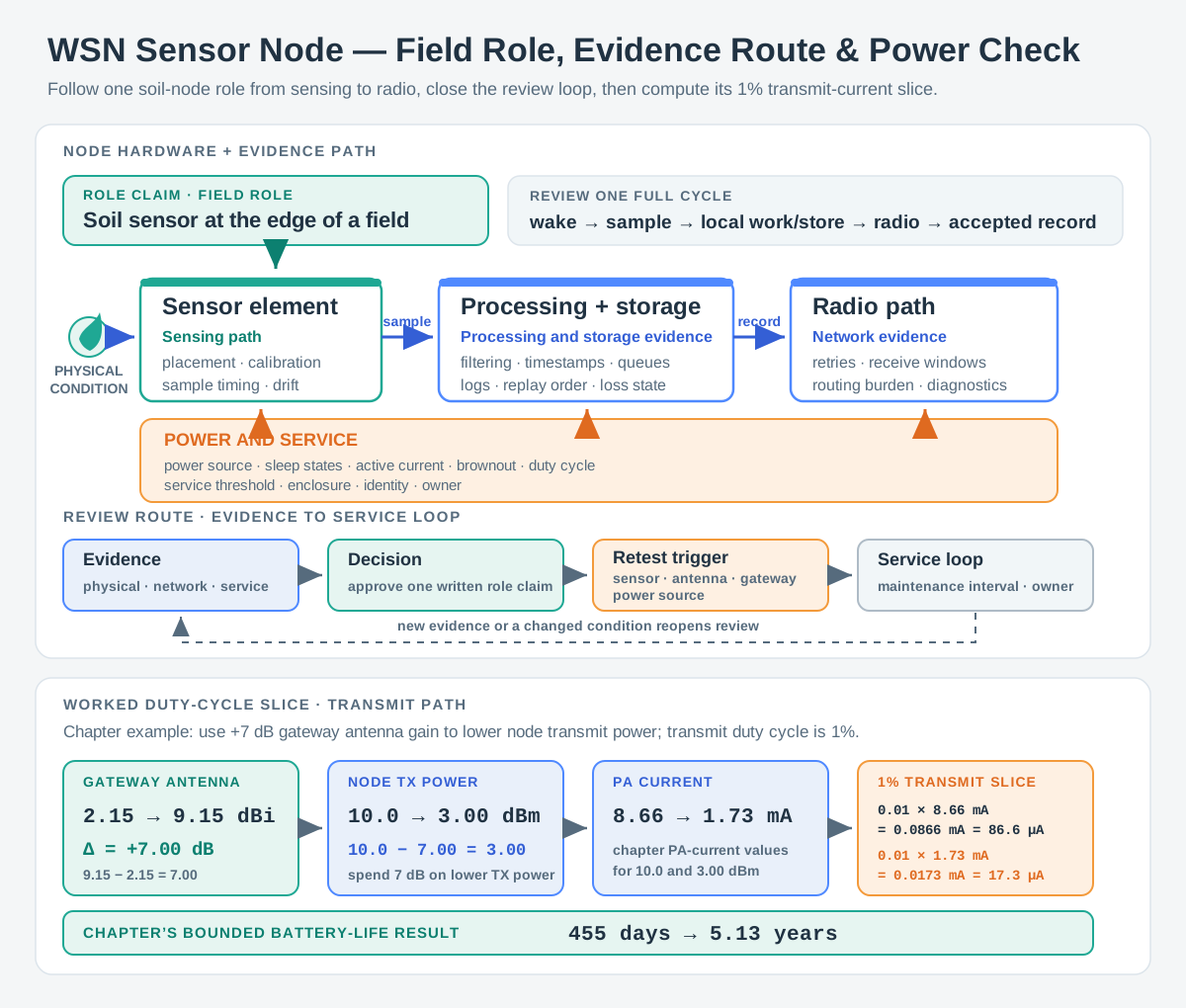
- The mathematical gist: Raising gateway antenna gain from 2.15 to 9.15 dBi adds 7.00 dB.
- A WSN sensor node is the field system that turns a physical condition into usable evidence.
- The goal is not to document every component detail.
Major section
Sensor Node Characteristics (continued)
Spend it on ideal free-space range and the multiplier is 2.24×; spend it on lower transmit power and 10.0 dBm becomes 3.00 dBm.
- It includes the sensor element, processing, radio, storage, power source, enclosure, firmware, identity, diagnostics, calibration path, and service plan.
- If you only need the intuition, this layer is enough: approve a sensor node for one written role claim.
- A useful record separates node subsystems from the claim they support.
Major section
Sensor Node Characteristics (continued)
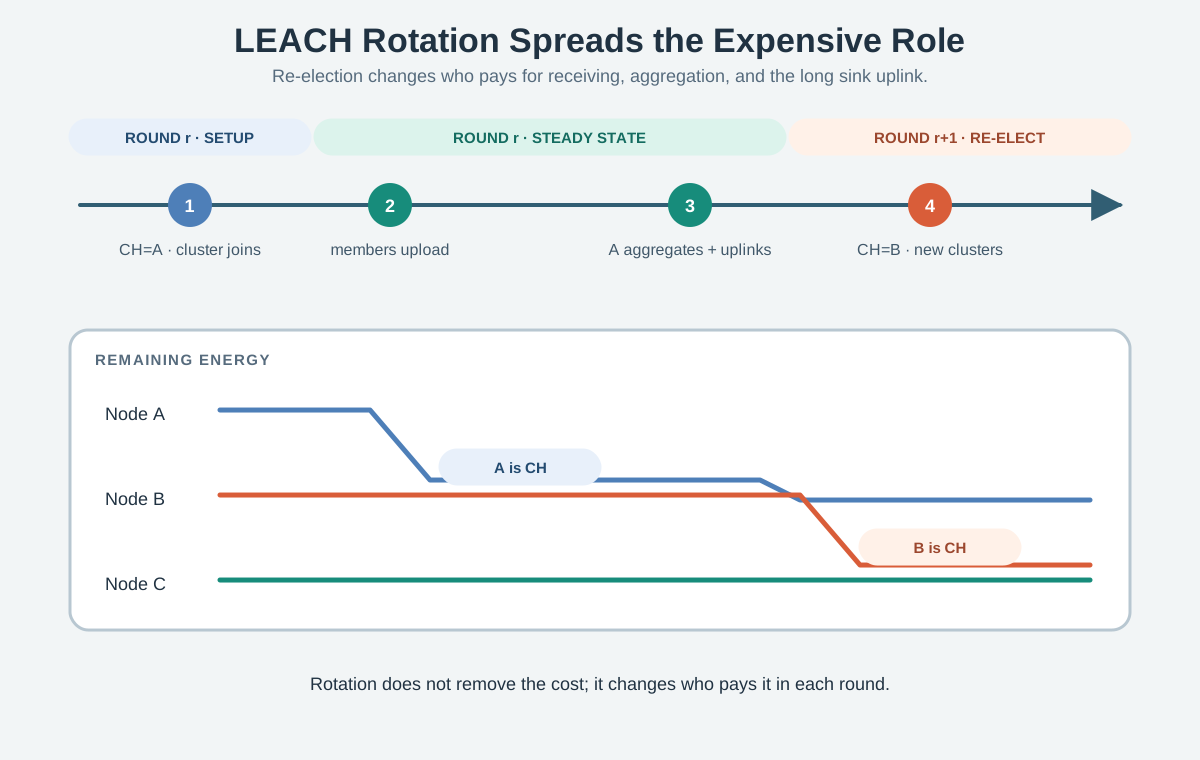
A leaf-node test is reused after the node becomes a relay, cluster head, mobile node, or gateway-adjacent node.
- The same rule applies to very small motes such as Michigan Micro Mote-style boards: miniaturization is interesting only after the review ties sensing, radio, storage, power, firmware, and service behavior to a field role.
- The sensor part is trusted even though mounting or environment changed the measurement.
- A relay node receives and forwards other nodes' traffic.
Major section
Sensor Node Characteristics (continued)
Topology, gateway, antenna, route policy, channel condition, traffic mix, or node role changes.
- Physical EvidencePlacement, calibration, warm-up, drift, saturation, environmental exposure, and reference checks show whether the node can observe the condition it claims to observe.
- Sensor model, placement, calibration method, sampling interval, enclosure, or reference condition changes.
- The packet may be sent but not acknowledged.
Major section
Sensor Node Characteristics (continued)
Network EvidenceRadio reach, retries, receive windows, routing burden, queue behavior, time labels, and gateway handoff show whether readings can leave the node with their meaning intact.
- Service EvidenceBattery threshold, enclosure access, firmware version, update behavior, diagnostics, identity, and maintenance ownership show whether the node can remain trustworthy after installation.
- Firmware update, configuration change, outage behavior, queue pressure, storage wear, or new event threshold appears.
- A gateway-adjacent node may carry concentrated traffic and command exposure.
Major section
Sensor Node Characteristics (continued)
The goal is to preserve enough evidence that another reviewer can see why the node is acceptable, what it cannot prove, and who owns the next action when evidence weakens.
- Sleep states, active current, brownout behavior, update window, service threshold, enclosure, identity, and owner.
- The node can work in theory but cannot be reached, diagnosed, recalibrated, powered, or replaced safely in the field.
- Battery chemistry, harvest source, duty cycle, enclosure, installation access, maintenance interval, or ownership changes.
Major section
Sensor Node Characteristics (continued)
A mobile node changes contact, location meaning, and custody.
- None of those burdens is proven by a leaf-node sensing test.
- Sensor-node record template Role claim: what this node must sense, forward, store, decide, or protect.
- Retest trigger: the exact sensor, firmware, antenna, gateway, traffic, enclosure, power, service, or application change that reopens review.
Major section
Sensor Node Characteristics (continued)
Most weak sensor-node decisions fail at a boundary.
- The value may be measured correctly but timestamped badly.
- The buffer may preserve data but replay it out of order.
- The firmware may recover but lose calibration state.
- The enclosure may protect the electronics but detune the antenna.
Major section
Sensor Node Characteristics (continued)
Measurement BoundarySensor output becomes evidence only after placement, calibration, timing, range, noise, drift, and quality flags are reviewed against the monitoring claim.
- Custody BoundaryOnce data enters firmware, queues, radio, routing, and gateway handoff, the record needs freshness, duplicate, missing-data, replay, and ownership evidence.
- Control BoundaryRemote commands, firmware updates, threshold changes, and actuator-adjacent decisions need stronger identity, authorization, rollback, and failure-state evidence.
- The under-the-hood rule is to avoid accepting silent assumptions.
Major section
Sensor Node Characteristics (continued)
A weak battery can corrupt timekeeping, reset firmware, shorten radio range, drop queue writes, or make diagnostics disappear.
- A resilient node review states how brownout is detected, how the node labels recovery, what data is discarded or preserved, and when service must act.
- Diagnostics are the bridge between hidden device behavior and an operator decision.
- Without those labels, the backend may display a clean value while the node is actually outside its approved boundary.
Major section
Sensor Node Characteristics (continued)
The node may look healthy because diagnostics are missing.
- Missing packets, low battery, stale timestamps, saturation, replacement, firmware rollback, and failed update attempts are not side notes.
- If a node decision depends on calibration, time, state, route, queue, key, battery, enclosure, or owner, that dependency should appear in the evidence record with a known limit and retest trigger.
- Processing, storage, and radio evidence must preserve freshness, ordering, replay, duplicate, loss, route, security, and diagnostic state.
Deck summary
Key takeaways
A node can send valid-looking values that clash with its neighbours.
- Scenario: a gateway notices that one node's current reading is missing.
- Firmware is the code that runs on a device.
- Extra logs can aid repair, but they use store, energy, and air time.
- Firmware hides missing, stale, filtered, or replayed data as if it were fresh evidence.
Retrieval practice
Recall check 1 of 4

Packet Pete says: answer from memory, then check your reasoning.
Q1A node still sends complete messages. Its values are possible by themselves, but they repeatedly conflict with nearby observations and the process state used by the application. What is the best classification for the affected decision?
Show answer
Answer: D Behavior classification should distinguish active but untrustworthy data from missing data and should stay tied to the affected decision.
Retrieval practice
Recall check 2 of 4
Packet Pete says: answer from memory, then check your reasoning.
Q2A WSN design review says a node is acceptable because the sensor board worked on a bench. What is the strongest next question?
Show answer
Answer: A A WSN sensor node should be approved against a written role claim, not against a generic board label.
Retrieval practice
Recall check 3 of 4
Packet Pete says: answer from memory, then check your reasoning.
Q3A soil-moisture leaf node is now being used as a relay for nearby nodes. Which evidence should the practitioner add before accepting the new role?
Show answer
Answer: B A sensor-node evidence record must be reviewed again when the field role changes, even if the hardware did not.
Retrieval practice
Recall check 4 of 4
Packet Pete says: answer from memory, then check your reasoning.
Q4What evidence must support the node buffering claim during an outage?
Show answer
Answer: C Sensor-node trust depends on boundary evidence: measurement, custody, firmware, radio, power, and service behavior must stay visible.
Print reference
Answers
Answer key.
- D · Behavior classification should distinguish active but untrustworthy data from missing data and should stay tied to the affected decision.
- A · A WSN sensor node should be approved against a written role claim, not against a generic board label.
- B · A sensor-node evidence record must be reviewed again when the field role changes, even if the hardware did not.
- C · Sensor-node trust depends on boundary evidence: measurement, custody, firmware, radio, power, and service behavior must stay visible.