LoRa & LoRaWAN · Study deck

LPWAN Fundamentals — Part 2

With the workload bounded, compare what each candidate requires from the site and its owners.

Radio Remi is your guide for this deck.

lpwan
Lpwan Fundamentals cover: Remi pointing across a tabletop landscape showing long-range low-power sensor links to a gateway.
iotclass.org

After studying this chapter

Learning objectives

You will be able to:

  • Identify LPWAN-shaped workloads from payload, cadence, latency, and downlink limits
  • Compare LPWAN design forces using radio, power, ownership, and operations evidence
  • Reject non-fit LPWAN claims and route them to better network paths
  • Write bounded LPWAN review records with evidence, risks, owners, and retest triggers
LPWAN architecture evidence path from endpoint through radio access, service layer, application, and operations.
iotclass.org

Major section

Vineyard Workload and Design Forces (1/2)
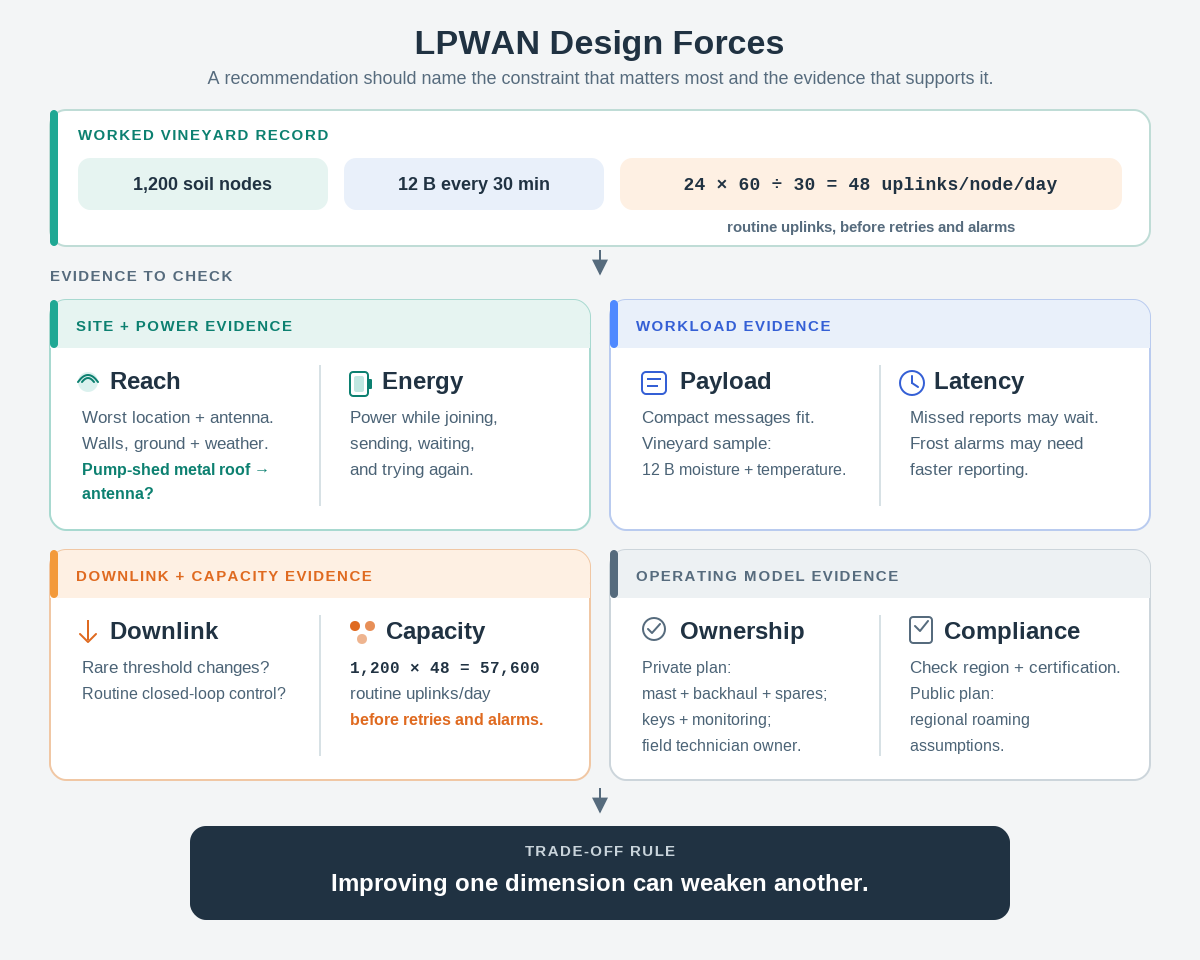
These design-force cards connect the vineyard workload with evidence; start at the example before comparing the cards.

  • The vineyard example is the design-force comparison’s starting point.Its 1,200 soil nodes must each send a 12-byte moisture and temperature sample every 30 minutes during irrigation season.
  • Reach requires a measured gateway or cell path.Installed antenna placement, terrain, and local observations must support the coverage claim for the actual vineyard.
Eight LPWAN design-force cards - reach, energy, payload, latency, downlink, capacity, ownership, and compliance - each listing what evidence to ask for, anchored by a worked example (vineyard: 1,200 nodes at 12 bytes every 30 minutes equals 48 uplinks per node per day) and a strip noting improving one force can weaken another.
iotclass.org

Major section

Vineyard Workload and Design Forces (2/2)

  • Energy and downlink must fit the application’s timing.Sleep, receive windows, retries, command frequency, and acknowledgments determine whether the workload can sustain the selected path.
  • Ownership and compliance constrain the final recommendation.Operating duties belong beside payload, latency, and capacity because improving one design force can weaken another.
iotclass.org

Activity 1 · Match

✎ Match the traffic requirements

I want you to sort the traffic before choosing a radio family.

Match these five workloads: fill-level reports, soil telemetry, CCTV clips, traffic-light actuation, firmware images. Meanings: A, routine bulk downloads; B, small readings for later route planning; C, control that cannot wait; D, media-heavy uploads; E, measurements from a sleeping field sensor. Then mark which workloads remain LPWAN candidates.

3 minutes · Pen and paper · Answer: Activity 1

Your answer
iotclass.org

Major section

Private and Public Operating Duties

Private and public networks move operating duties to different owners.

  • Private gateways require an infrastructure operating plan.Mast locations, backhaul, spares, keys, and monitoring must be provided for the vineyard’s privately managed path.
  • Private infrastructure needs a field technician owner.The plan must assign responsibility for gateway maintenance and failures rather than leaving the installed equipment unsupported.
  • A public service requires lifecycle and outage arrangements.Availability, accounts, regional roaming, escalation, and an exit path must be reviewed if service coverage changes.
  • Radio performance alone cannot prove maintainability.Private and public paths move ownership and service dependencies to different places that need explicit evidence.
I am comparing private gateways with a public service for the vineyard. I name the people and records needed to restore operation before comparing the radio claims.
iotclass.org

Activity 2 · Predict

✎ Add the calibration download

I want you to explain why one product can need separate communication paths.

The cold-chain tag adds a weekly 250 kB calibration package to its temperature heartbeat. Predict the effects on receive time, battery use, and interrupted-transfer handling. Sketch the revised path choice.

3 minutes · Pen and paper · Answer: Activity 2

Your answer
iotclass.org

Major section

Vineyard Alarms and Installation Changes

The vineyard record must include traffic beyond the routine soil sample.

  • The routine cadence is only the starting workload.Each node sends 48 routine uplinks per day before any additional retries or alarms are included.
  • Frost alarms can require faster reporting.The operating record must distinguish urgent frost behavior from the regular moisture and temperature sampling cadence.
  • Metal roofs can change antenna installation needs.Pump-shed coverage may require external antennas rather than relying on an unchanged node placement.
  • Threshold changes and closed-loop control have different requirements.Rare configuration commands can be patient, while routine control may change the technology-family shortlist.
I am reviewing traffic beyond the vineyard’s routine moisture readings. I check frost alarms, metal pump-shed roofs, and command needs before accepting the original cadence.
iotclass.org

Major section

Practitioner: Compare Design Forces and Operating Models (continued)

Include sensing and other non-radio work: low transmit duty alone cannot establish battery life.

  • Receive-window behavior, acknowledgement policy, and local fallback determine whether the application can wait.
  • A coverage result cannot substitute for either a power model or a command policy.
  • The real deployment determines which parts of a headline remain defensible.
iotclass.org

Major section

Antenna Aim And Off-Axis Risk

Antenna gain is another claim that needs a boundary: a directional antenna helps only while it remains aimed.

  • The separate Math Bridge works through the vineyard node's orientation risk.
  • The aimed 20 dBm EIRP (equivalent isotropically radiated power, also called effective isotropic radiated power) gives a 2.00× ideal range ratio.
iotclass.org

Major section

Antenna Aim And Off-Axis Risk (continued)

The mathematical gist: This chapter's 6 dBi (decibels of gain relative to an antenna radiating equally in all directions) patch is 3.98× linear gain.

  • Half-power beamwidth is the angle between the points on either side of the peak where the power drops to half its peak value in a given plane.
  • Converting that width to degrees gives 4π/3.98×180/π≈101.8∘\sqrt{4\pi/3.98}\times 180/\pi \approx 101.8^\circ4π/3.98​×180/π≈101.8∘, or 28.3% of a full turn in one plane.
  • The vineyard node needs to stay aimed to retain the gain used in the link budget.
iotclass.org

Major section

Workloads That Need Another Path

This non-fit filter identifies demands that need another path; begin with Streaming and Tight control.

  • Streaming media is outside the compact-message assumption.The first non-fit signal covers media or waveforms that require a different volume of data from sparse telemetry.
  • Tight control cannot depend on delayed wide-area delivery.A command that cannot wait does not share the timing tolerance expected of the chapter’s sleeping sensors.
  • Bulk updates and frequent commands add transfer demands.Large downloads and repeated downlink increase receive time, battery use, and interrupted-transfer handling requirements.
  • Unsupported operations also require a redesign.A working radio link is insufficient when gateway maintenance or service ownership has no responsible team.
LPWAN non-fit filter routing streaming media, tight control, bulk updates, frequent commands, and unsupported operations away from LPWAN.
iotclass.org

Major section

Review Records and Retest Triggers

A review record pairs each claim with the conditions that require another review.

  • The claim must name the workload and deployment scope.Region, candidate family, measured evidence, and weak assumptions belong in the review record before release.
  • Each weakness needs mitigation and an owner.The record must connect a known risk to an action and a person responsible for following the evidence.
  • Installation and service changes can invalidate the pilot.Enclosure revisions, antenna relocation, subscription changes, and moves between regions are explicit retest triggers.
  • Increased sampling can reopen link and capacity evidence.A request for ten times more samples changes the workload behind the old pass and can require another access technology.
LPWAN fundamentals review record with claim, evidence, risk, mitigation, owner, and next chapter route.
I am revisiting a pilot after an enclosure change reduces antenna clearance. I need the old claim, its evidence, and an owner who can decide which tests must run again.
iotclass.org

Major section

Temperature Telemetry and Calibration Downloads

The cold-chain tag needs different paths for temperature reporting and calibration downloads.

  • A compact temperature heartbeat can fit LPWAN.The cold-chain tag’s five-minute report is a candidate when its payload is small and delayed arrival is acceptable.
  • The calibration package has a different transfer shape.A weekly 250 kB download requires thousands of small fragments and long receive time even before protocol overhead.
  • Interrupted transfers need their own operating plan.The calibration path adds retry handling, battery use, and recovery responsibilities beyond the routine temperature report.
  • Bulk calibration can use a separate maintenance connection.The chapter routes the package through depot Wi-Fi or a wired cradle while keeping temperature telemetry on LPWAN.
I am reviewing a cold-chain tag that adds a weekly calibration package. I keep its temperature heartbeat on one path and give the bulk download a separate maintenance route.
iotclass.org

Activity 3 · Predict

✎ Add the calibration download

I want you to explain why one product can need separate communication paths.

The cold-chain tag adds a weekly 250 kB calibration package to its temperature heartbeat. Predict the effects on receive time, battery use, and interrupted-transfer handling. Sketch the revised path choice.

3 minutes · Pen and paper · Answer: Activity 3

Your answer
iotclass.org

Major section

Under the Hood: Non-Fit Signals and Review Records (continued)

Even before protocol overhead, that download would require thousands of small payload fragments, long receive time, more battery energy, retry handling, and an operational plan for interrupted transfers.

  • If each fragment has room for 50 file bytes after its headers, the tag needs 250,000 ÷ 50 = 5,000 fragments before retries.
  • Those triggers stop a valid pilot from becoming an unreviewed production assumption six months later.
  • The calibration package stays pending until the tag reaches the depot.
  • At the depot, the tag receives the file over Wi-Fi or through a wired cradle.
iotclass.org

Major section

Under the Hood: Non-Fit Signals and Review Records (continued)

If the transfer is interrupted, the tag keeps using its current calibration.

  • Streaming media or waveforms require a different path from sparse telemetry.
  • Tight control “cannot wait”; repeated bulk updates and frequent cloud commands change the receive and power assumptions.
  • A release-ready record also keeps arithmetic close to the decision.
iotclass.org

Major section

Under the Hood: Non-Fit Signals and Review Records (continued)

If a device normally sends 12 bytes every 15 minutes, the reviewer should record the daily message count, the alarm burst assumption, and the retry budget used in the pilot.

  • Scheduled reports per day: 24 × 60 = 1,440 minutes, then 1,440 ÷ 15 = 96 reports.
  • That gives up to 100 retries and 100 + 100 = 200 total transmission attempts for the day.
  • Separate the claim—what is true—from the evidence—why it should be trusted.
  • A weakness needs a mitigation and a responsible person, not just a warning in the record.
iotclass.org

Major section

Summary

An LPWAN recommendation is useful when its operating limits and evidence remain explicit.

  • The message shape must justify the LPWAN role.Size, cadence, delay tolerance, and downlink requirements determine whether the workload remains small and patient.
  • Installed measurements must bound range and battery claims.Site reach and a complete energy model need the actual antenna, sleep behavior, receive windows, and retries.
  • The architecture must include service and failure ownership.Gateway duties, service dependencies, and recovery responsibility remain necessary even when compact telemetry works in a pilot.
  • Unsuitable traffic must move to another path or design.Changed payload, region, antenna, service, or ownership requires renewed review rather than extending an old claim without evidence.
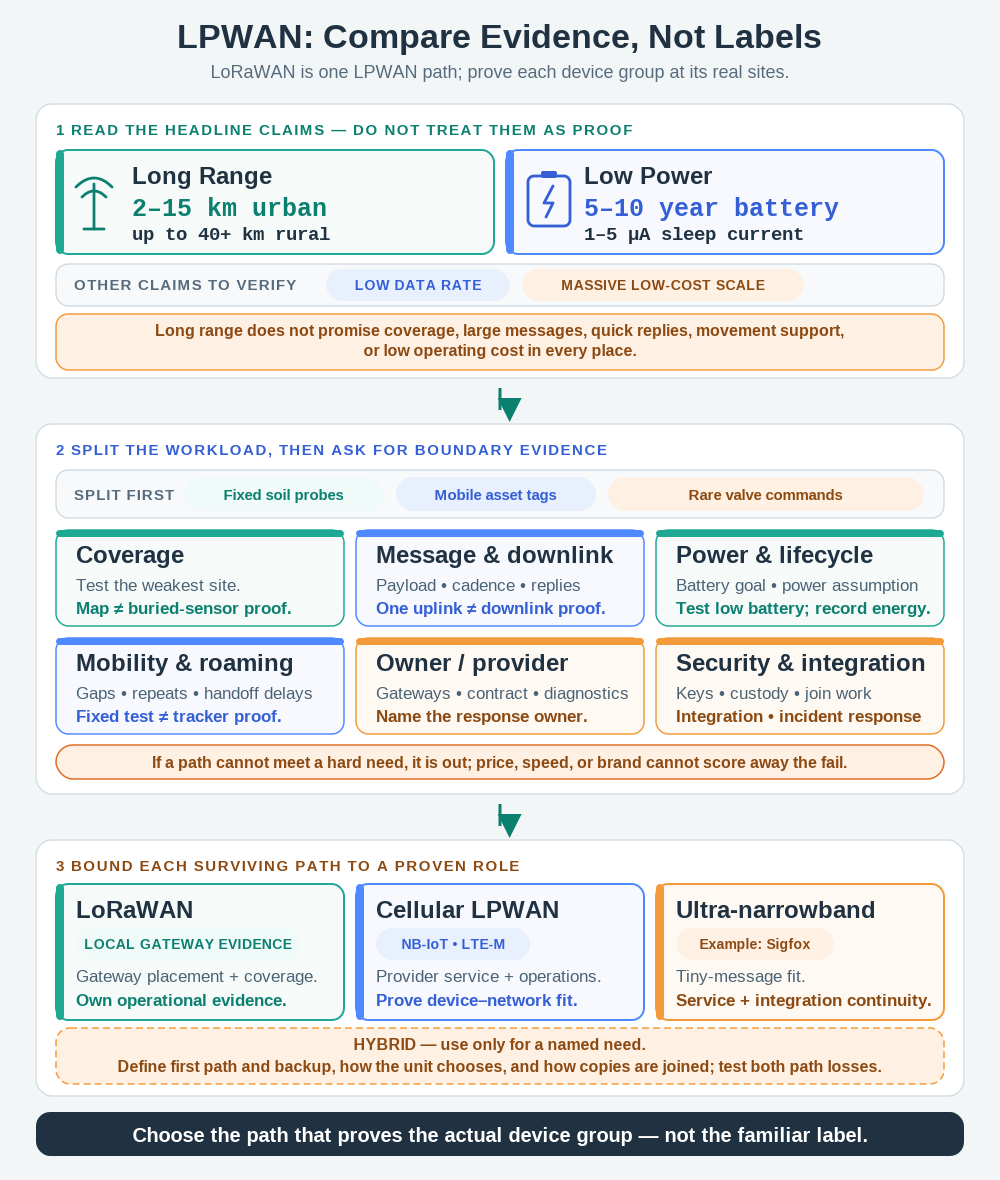
LPWAN review moves from headline claims to device-group evidence and a proven role for LoRaWAN, cellular or ultra-narrowband service. A hard requirement failure rules out a path.
iotclass.org

Deck summary

Key takeaways

This comparison places different workloads inside radio envelopes; compare the tablet with the remote tank.

  • The nearby tablet needs a high-rate traffic path.The Wi-Fi region fits its bulk transfer workload rather than the remote tank’s sparse observations.
  • Local-link options have a distinct role in the comparison.Bluetooth LE and 802.15.4 have a different rate and range envelope from wide-area telemetry.
  • LPWAN can fit the remote tank’s patient reports.The LoRa region matches tens-of-bytes telemetry over kilometres when the operating evidence supports the path.
  • The plotted envelope is not a deployment guarantee.Payload, cadence, latency, link margin, regulation, terrain, gateways, and retry energy must support the selected radio role.
iotclass.org

Print reference

Activity 1 answer

Model answer.

Match: Fill-level reports match B; soil telemetry matches E; CCTV clips match D; traffic-light actuation matches C; firmware images match A. Compact, patient fill-level reports and soil telemetry remain LPWAN candidates, subject to field evidence. Media, tight control, and routine bulk downloads need another path or redesign.

iotclass.org

Print reference

Activity 2 answer

Model answer.

Predict: Fragmentation increases receive time, energy use, and retry handling. Keep compact, delay-tolerant temperature telemetry on LPWAN, subject to evidence. Route calibration packages through depot Wi-Fi or a wired cradle and record responsibility for interrupted transfers.

iotclass.org

Print reference

Activity 3 answer

Model answer.

Predict: Fragmentation increases receive time, energy use, and retry handling. Keep compact, delay-tolerant temperature telemetry on LPWAN, subject to evidence. Route calibration packages through depot Wi-Fi or a wired cradle and record responsibility for interrupted transfers.

iotclass.org