Security: Threats & Defense · Study deck
IoT Security Fundamentals — Part 2
The strongest review names the asset, locates the trust boundary where the claim is enforced, states the threat, maps a control, and records both the allowed and the denied behavior that were observed.
Shield Shelly is your guide for this deck.

After studying this chapter
Learning objectives
You will be able to:
- name the asset, surface, and evidence needed to support a security claim
- explain why constrained devices change the security shape across top, middle,
- Explain: The strongest review names the asset, locates the trust boundary where the claim is enforced, states the threat, maps a control, and records both the allowed and the denied behavior that were observed.
- Explain: A broker receives messages and passes them to subscribers.
Major section
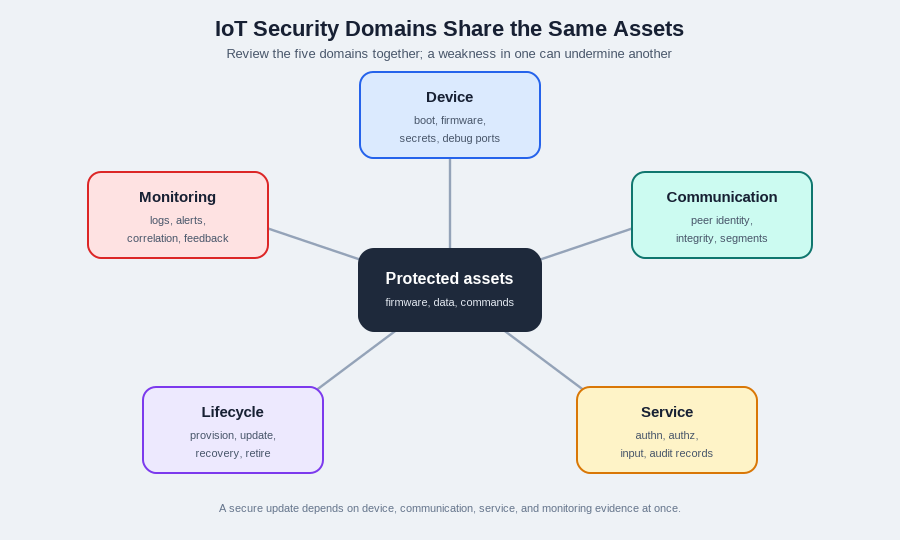
Follow the five domain spokes (1/2)
Start at the wheel’s central assets, then follow the domain spokes that protect them.
- Firmware, data and commands sit at the centre of the claim.Firmware is software stored on a device that tells its hardware how to operate; the wheel keeps it, data, and commands visible across every domain.
- Follow device and communication spokes toward their exposure points.Hardware controls, peer identity, and message protection contribute different evidence.
Major section
Follow the five domain spokes (2/2)
- Separate authentication from authorization at services.Authentication checks who makes a request; authorization decides what they may do. Services also handle input, protect stored data, and keep audit records.
- Lifecycle and monitoring connect maintenance with detection and response.Provisioning is initial setup assigning a device its owner, identity, and credentials; updates, retirement, logs, and alerts support it over time.
Major section
Match the control to its proof
Different control types need different demonstrations of success.
- Preventive evidence shows an unauthorized action being refused.Secure boot and input validation check software and values before use. Authorization or segmentation needs a denied case beside its configured rule.
- Detective evidence shows the intended event producing a log or alert.The observation must exercise the event the control is meant to catch.
- Corrective evidence compares states before and after recovery.Credential rotation or firmware rollback needs a tested recovery run.
- A configured feature alone does not establish these outcomes.Each control type needs evidence that demonstrates its own purpose.
Activity 1 · Match
✎ Match each control to its proof
I want you to pair each control with an observation that actually tests its purpose.
Match authorization, segmentation, audit logging, credential rotation, and firmware rollback to these proofs: denied publish, blocked traffic, recorded event, tested credential recovery, and tested firmware recovery. Mark each pair preventive, detective, or corrective.
4 minutes · Pen and paper · Answer: Activity 1
Major section
Test the actuator-command boundary
The actuator-command example makes a narrow security claim reviewable.
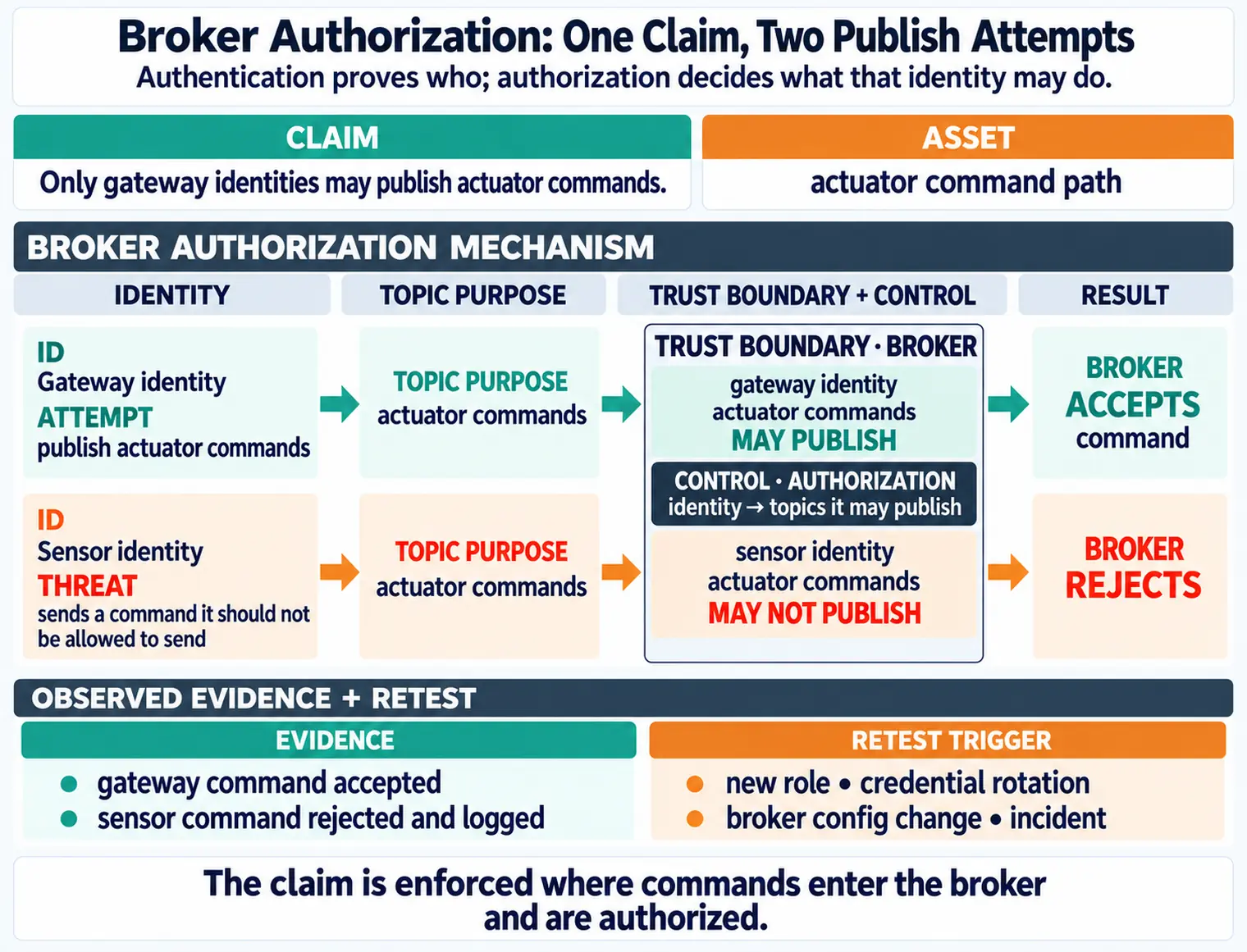
- Name the broker entry point enforcing command permissions.A broker receives messages and passes them to subscribers; a narrow claim can state that only gateway identities may publish actuator commands.
- Tie each identity to its permitted publish topics.A topic is a named channel used to sort messages; sensor and gateway roles get different decisions.
- Keep the accepted gateway test and logged sensor refusal.Together with the rules, they show both allowed and denied behavior.
- Retest after changes that affect the claim.New roles, credential rotation, broker configuration changes, or incidents reopen the review.
Major section
Build a Security Claim You Can Test (continued)
A tested recovery run with a recorded before-and-after state.
- At a service, authentication means checking who is making a request; authorization decides what that person or device may do.
- Residual risk is the chance of harm that remains after controls are applied.
- A detective control needs proof that it actually fires.
Major section
Build a Security Claim You Can Test (continued)
In the interactive, follow a device from first owner binding, which links it to its owner’s account, through credential issue, which gives it a secret or certificate to prove its identity, and lifecycle evidence.
- Two preventive controls need plain descriptions: secure boot checks that trusted software is present before the device runs it; input validation checks incoming values before the software uses them.
- A log or alert that fires on the event it is meant to catch.
- A preventive control needs a denied case, not just an allowed one.
Major section
Why Boundaries and Layers Matter
The deeper layer explains why the review pattern works.
- Three ideas do most of the work: the security properties an asset can have, the trust boundaries where those properties are decided, and the layered defense that keeps one failure from becoming a total failure.
- A valid identity therefore does not automatically gain permission to send every command.
Major section
Why Boundaries and Layers Matter (continued)
After the layers are placed, some residual risk always remains.
- In this broker example, the trust boundary is where gateway and sensor messages enter the broker and their permissions are checked.
- Authentication checks who is sending each message; authorization decides which topics that identity may use.
- The specific crossing point and the check that runs there.
Major section
Why Boundaries and Layers Matter (continued)
The claim has no place to be tested or to fail.
- The broker accepts the gateway's actuator command and rejects the sensor's command.
- Its attack surface includes those message connections and the broker settings that decide which identity may publish to the actuator topic.
- An assurance that cannot be reproduced or checked.
Major section
Why Boundaries and Layers Matter (continued)
The logged rejection and accepted command give the reviewer evidence to retest after a role or broker configuration change.
- At the broker trust boundary, the authorization control maps each identity to the topics it may publish: the gateway may publish, while the sensor may not.
- The results provide both allowed and denied evidence, and the retest trigger keeps that evidence honest after a relevant change.
- Old evidence is trusted long after the system changed.
Major section
Why Boundaries and Layers Matter (continued)
If device authentication, network segmentation, and service-side authorization are truly independent, an attacker must defeat all three rather than one.
- The key word is independent: three controls that all rely on the same secret are really one control.
- A record lets the next reviewer see the claim, its test, and when the test must be repeated.
- Trusting a diagram: Intent on a slide is not the same as a tested boundary.
Major section
Why Boundaries and Layers Matter (continued)
Reviewing the device but skipping lifecycle: A hardened device with an unverified update or recovery path still has an open door.
- Stacking dependent layers: Controls that share one secret or one assumption are one control wearing three hats.
- Letting evidence go stale: Without retest triggers, a passing result silently expires after the next change.
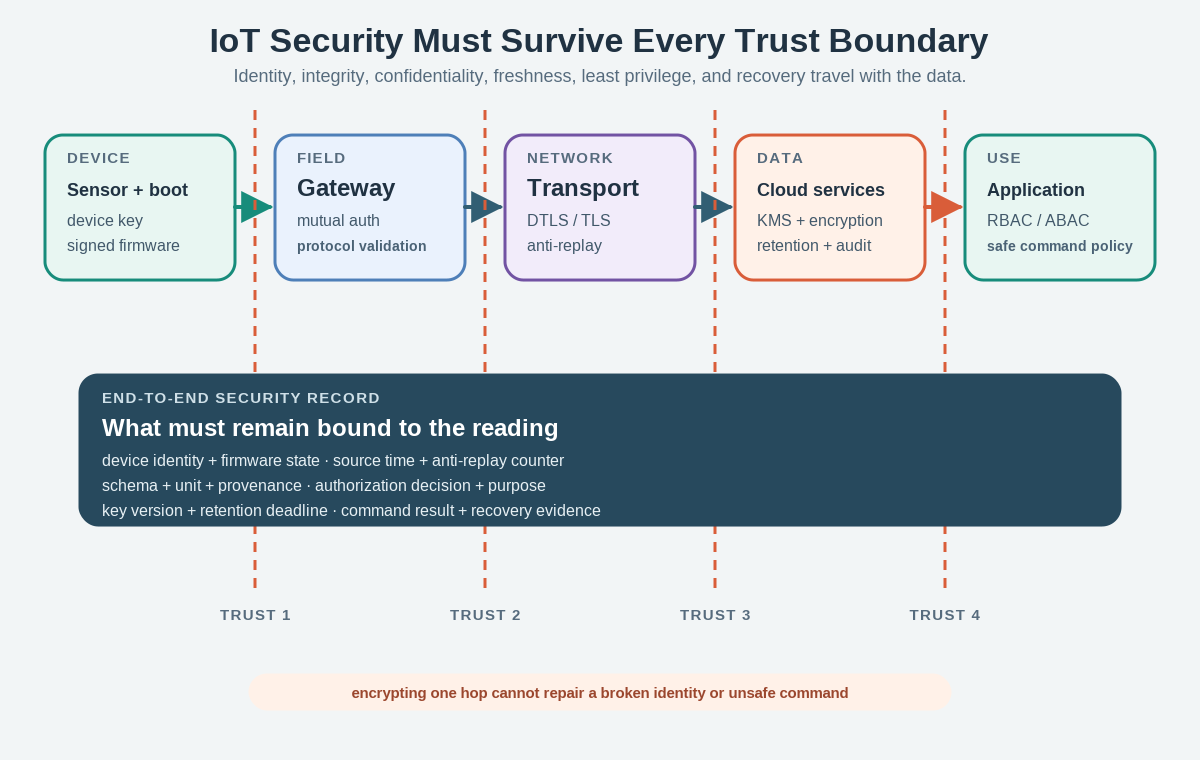
- The layered threat surface in Figure: Device makes every transition an explicit control and evidence boundary.
Major section
Why Boundaries and Layers Matter (continued)
At this depth, IoT security is a discipline of naming: name the asset and its properties, name the boundaries where those properties are decided, layer independent controls, and keep a record whose evidence has an expiry.
- A trustworthy security claim is narrow, tested in both the allowed and denied direction, and tied to the change that would make you check it again.
- In Figure: Device, TRUST 1 follows device identity into the: Gateway: TRUST 2 comes before: Transport; later boundaries protect cloud and application use.
- Each receiver must know who sent it and whether it is fresh and intact.
Major section
Summary
IoT expands security from high-compute personal devices into middle- and bottom-tier connected products whose update capacity, manufacturer maturity, and network reach vary widely.
- The CIA triad, plus authentication, authorization, and safety, gives precise language for what a control actually provides.
- A trust boundary is where trust changes; the attack surface is the union of every place an asset can be reached.
- Preventive, detective, and corrective controls each need their own evidence, including a denied case for preventive controls.
Deck summary
Key takeaways
Start with an asset, test the guard at its boundary, and record what remains at risk.
- Name assets and reachable surfaces before selecting controls.A command path or credential needs a specific boundary where its protection can be tested.
- Keep security properties, identity, permission, and safety claims distinct.Evidence for a private channel does not establish permission to move an actuator.
- Independent layers limit the effect of one defeated control.Shared secrets or assumptions can make several apparent protections fail together.
- Record residual risk and the changes that reopen the review.A trustworthy claim remains narrow, reproducible, and tied to its observed operating conditions.
Retrieval practice
Recall check 1 of 2
Shield Shelly says: answer from memory, then check your reasoning.
Q1A design claim says only gateway identities can publish actuator commands. Which evidence best supports it?
Show answer
Answer: A A role boundary needs both the allowed case and the denied case, with the rejection visible in evidence.
Retrieval practice
Recall check 2 of 2
Shield Shelly says: answer from memory, then check your reasoning.
Q2A reviewer is told a device is protected by three layers: a device certificate, network segmentation, and service authorization. What is the most important thing to verify about the layers?
Show answer
Answer: D Defense in depth only adds strength when layers fail independently.
Print reference
Answers
Answer key.
- A · A role boundary needs both the allowed case and the denied case, with the rejection visible in evidence.
- D · Defense in depth only adds strength when layers fail independently.
Print reference
Activity 1 answer
Model answer.
Match: Authorization → denied publish and segmentation → blocked traffic are preventive. Audit logging → recorded event is detective. Credential rotation → tested credential recovery and firmware rollback → tested firmware recovery are corrective; record their before-and-after states.