Electronics & Circuits · Study deck

Diode Clamp and Recovery Contracts

Imagine a signal line that may be driven slightly below ground or above the supply during a wiring mistake.

Voltage Vera is your guide for this deck.

diodeclamprecovery
Voltage Vera, the module guide, in a scene from this chapter.
iotclass.org

After studying this chapter

Learning objectives

You will be able to:

  • Treat the silicon 0.7 V diode drop as a current- and temperature-dependent approximation, not a fixed constant.
  • Size series resistance so GPIO clamp diodes divert only safe transient current.
  • Choose Schottky or PN diodes for reverse-polarity, flyback, and switching paths based on drop, recovery, and blocking needs.
  • Account for forward-voltage temperature drift and reverse-recovery charge in protection and converter designs.
iotclass.org

Major section

Start Simple

A clamp diode can protect the input only if the excess current has a safe path and stays within the rating.

  • GPIO means general-purpose input/output, a programmable digital pin on a controller.
  • This test covers one clamp path and stated limits, not every surge.
  • The walkthrough connects the familiar “0.7 V” rule to the real review questions of current path, rating, and recovery.
iotclass.org

Major section

Practitioner: Clamp Diodes Protect an Input
For practitioner: clamp diodes protect an input, these labels identify the boundary where an assumption must become a calculation or measurement.

  • The upper clamp diode conducts once the pin exceeds about 3.3 + 0.6 = 3.9 V, holding the pin near 3.9 V.
  • Most microcontroller GPIO and ADC pins already contain two internal clamp diodes: one from the pin to Vcc and one from the pin to GND.
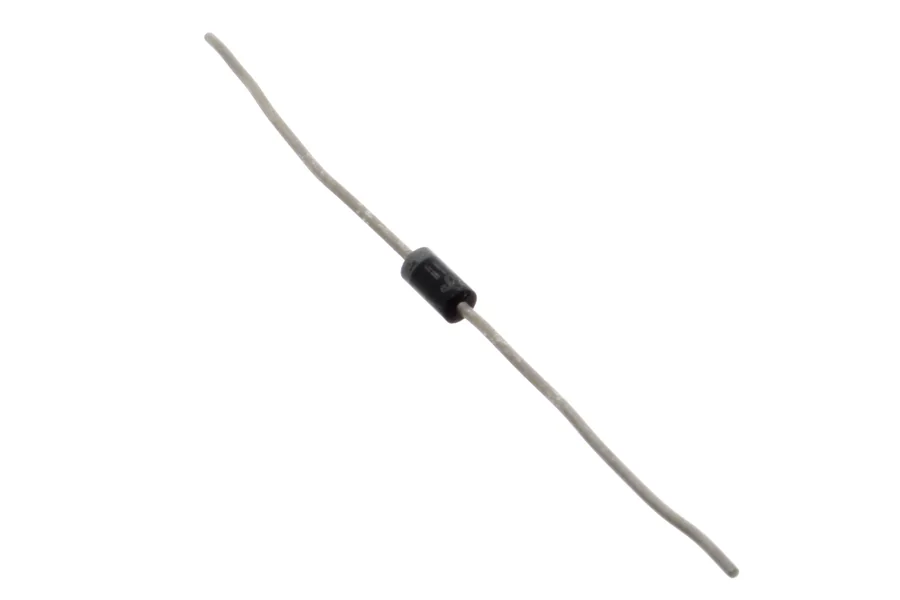
This axial-leaded silicon diode is the discrete version of what a GPIO pin already carries internally -- the same ~0.7 V-drop part class the text contrasts with the lower-drop Schottky recommended above for series reverse-polarity protection on a battery device. Photo: oomlout, CC BY-SA 2.0
iotclass.org

Major section

Under the Hood: Temperature Drift and Reverse Recovery

That drift is useful only when it is intentional and calibrated.

  • In a protection circuit it can move a threshold by hundreds of millivolts across an outdoor enclosure's operating range.
  • A general-purpose 1N400x diode can be fine on a rectified mains or slow relay path and still be the wrong part in a 100 kHz converter.
  • The trade is not free: Schottkies usually have higher reverse leakage and lower reverse-voltage ratings than comparable PN parts.
iotclass.org

Major section

Release Checklist

GPIO or ADC clamp current is limited by a series resistor and compared with the pin's absolute-maximum ratings.

  • Sustained level shifting is handled by a divider, buffer, or translator rather than relying on internal clamps.
  • Flyback and switching diodes meet reverse-voltage, forward-current, surge, and recovery-time needs.
  • Reverse-recovery loss is reviewed for PWM, switching converters, and fast inductive loads.
iotclass.org

Deck summary

Key takeaways

A clamp diode can protect the input only if the excess current has a safe path and stays within the rating.

  • For practitioner: clamp diodes protect an input, these labels identify the boundary where an assumption must become a calculation or measurement.
  • That drift is useful only when it is intentional and calibrated.
  • GPIO or ADC clamp current is limited by a series resistor and compared with the pin's absolute-maximum ratings.
iotclass.org

Retrieval practice

Recall check 1 of 3

Voltage Vera says: answer from memory, then check your reasoning.

Q1"A silicon diode always drops exactly 0.7 V." How should this rule be treated?

AAs a rough forward-bias estimate that varies with current and temperature
BAs an exact forward drop for every silicon diode and condition
CAs a fixed 0.7-ohm resistance rather than a nonlinear diode curve
DAs a value applying only in reverse bias rather than forward bias
Show answer

Answer: A see answers page

iotclass.org

Retrieval practice

Recall check 2 of 3

Voltage Vera says: answer from memory, then check your reasoning.

Q2A brief 5 V signal reaches a 3.3 V input through a 10 kohm series resistor and the pin survives. How do the pin's clamp diode and the resistor protect it?

AThe clamp acts as a series drop before current reaches the input pin.
BThe upper clamp shunts current near Vcc + 0.6 V; the resistor limits it.
CThe resistor alone makes a high-impedance 5 V signal become exactly 3.3 V.
DThe resistor raises the pin to 5 V rather than limiting clamp current.
Show answer

Answer: B see answers page

iotclass.org

Retrieval practice

Recall check 3 of 3

Voltage Vera says: answer from memory, then check your reasoning.

Q3Why is a standard silicon PN rectifier a poor choice for a high-frequency switching converter, while a Schottky diode works well?

ABecause PN minority-carrier charge causes costly reverse recovery at high frequency.
BBecause PN forward voltage is supposedly too low for switching converters.
CBecause Schottky parts supposedly block reverse voltage better than PN diodes.
DBecause PN diodes supposedly cannot conduct above a few hertz.
Show answer

Answer: A Reverse-recovery charge in a PN diode must be swept out each switching cycle, wasting energy at high frequency.

iotclass.org

Print reference

Answers

Answer key.

  1. A · The exponential I-V relationship means Vf is a soft, condition-dependent value (roughly 0.6-0.7 V at common currents), not a fixed constant. (Also: Vf shifts with current and temperature and is only near 0.7 V at typical currents.).
  2. B · The upper clamp conducts near Vcc + 0.6 V, or about 3.9 V in this example. The 10 kohm resistor limits the estimated diverted current to (5 - 3.9)/10k = 0.11 mA. Verify that this is within the actual pin's clamp-current rating; survival alone does not specify that rating.
  3. A · Reverse-recovery charge in a PN diode must be swept out each switching cycle, wasting energy at high frequency.
iotclass.org