Emerging Paradigms · Study deck
DTN Social Routing: Community and Forwarding Decisions
A popular node is not always the best carrier for a given community.
Blueprint Bina is your guide for this deck.
After studying this chapter
Learning objectives
You will be able to:
- Explain: A copy moves only when a neighbor's interest-specific utility exceeds the current carrier's by the configured hysteresis margin ϵ; it is delivered directly to an interested subscriber when encountered.
- Explain: SocialCast transfers a copy when the neighbor's interest-specific utility exceeds the current carrier's by the configured hysteresis margin ϵ; it delivers directly to interested subscribers when encountered.
- Explain: B's three encounters per day offer more frequent contact opportunities than A's one encounter per week; these rates alone do not establish a delivery probability.
- Explain community-aware SocialCast forwarding.
Major section
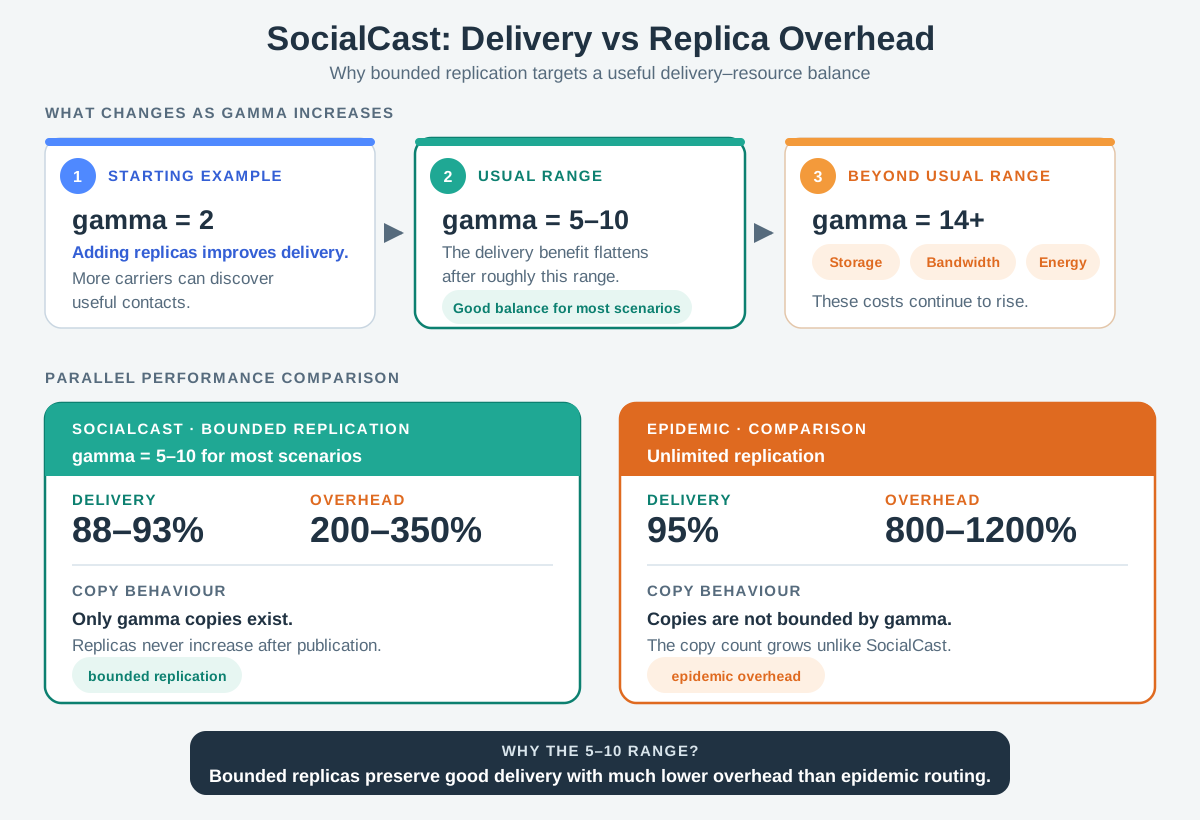
Figure Summary: SocialCast Workflow
A copy moves only when a neighbor's interest-specific utility exceeds the current carrier's by the configured hysteresis margin ϵ; it is delivered directly to an interested subscriber when encountered.
- Subscriber participation: Subscribers with high utility can act as carriers.
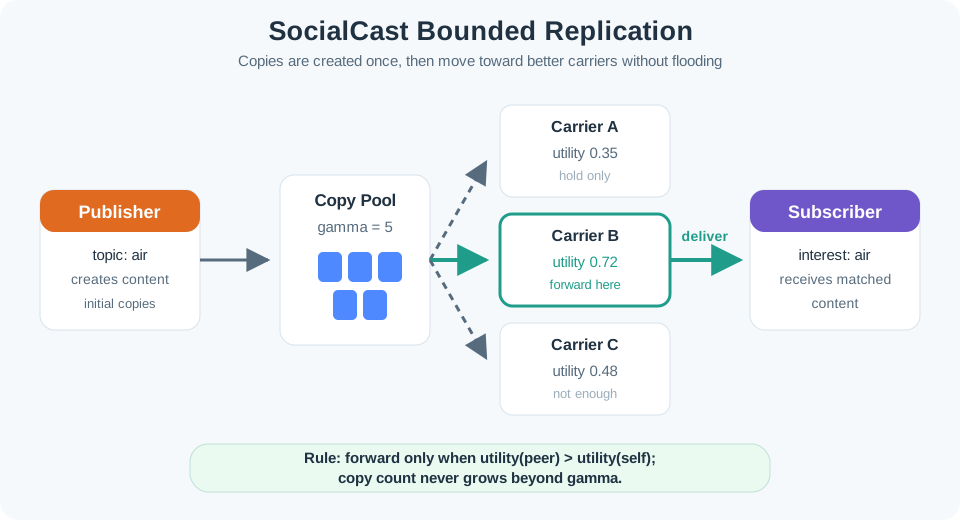
- Delivery rises at first, then the gain starts to flatten near five to ten copies.
- In that illustrative trace, epidemic spread gives 95% delivery with 800% to 1,200% overhead.
Major section
Figure Summary: Gamma Trade-off
In the same illustrative trace, epidemic routing delivers 95% with 800–1,200% overhead.
- TTL Impact: Longer TTL values usually improve delivery in sparse networks because a copy has more time to encounter a better carrier or subscriber.
- The trade-off is buffer pressure: every extra hour of TTL keeps stale data in constrained devices longer.
- More replicas improve delivery because more carriers can discover useful contacts.
Major section
Selection Workflow: Resource-Aware Teaching Score
A transfer decision requires the configured margin; these encounter rates do not establish delivery probability.
- Key Insight: SocialCast uses interest-specific predictions of subscriber colocation and connectivity change, with a hysteresis margin to limit oscillation.
Major section
Answer
For battery-constrained IoT devices, this resource efficiency is critical.
- In this illustrative trace, delivery falls from 95% to 88%, a seven-percentage-point decrease; whether that trade-off is acceptable depends on the mission.
Major section
Answer
SocialCast transfers a copy when the neighbor's interest-specific utility exceeds the current carrier's by the configured hysteresis margin ϵ; it delivers directly to interested subscribers when encountered.
- B's three encounters per day offer more frequent contact opportunities than A's one encounter per week; these rates alone do not establish a delivery probability.
Major section
Case Study: Community-Managed Mesh Links
Community Wi-Fi mesh networks are not automatically DTNs, and they are not formal SocialCast deployments.
- Utility function: local operators know which rooftop links, relays, or users are reliable.
- Bounded replication: popular files are cached on a small number of reliable mirrors instead of copied everywhere.
- Design lesson: social routing should be treated as an engineering trade-off, not a magic replacement for connectivity.
- It works best when contact patterns are predictable, resources are scarce, and forwarding decisions can be made from recent local evidence.
Major section
Social Contacts Are Not Stable
Work schedules, commuting patterns, and social behavior change over weeks and months.
- Routing decisions based on stale contact history (months old) may be less accurate than routing based on current network state.
Major section
Social Centrality Without Full Map
Betweenness centrality requires global network graph knowledge -- knowing all nodes and their interconnections.
- In a distributed DTN, this information is unavailable.
- Practical social routing uses local approximations (encounter counts, two-hop neighbor counts) that underestimate true centrality.
Major section
Contact Tracking Privacy Risks
Social routing requires nodes to share and track contact history.
- This creates detailed records of who met whom and when -- personal location data.
- Deployments must consider privacy implications and anonymization techniques.
- Publishing contact graphs can reveal sensitive information about individuals' movements.
Major section
Key Takeaway
Social routing uses repeated contact patterns, communities, or central nodes to improve DTN forwarding.
- It only works when those patterns are real, measured, and acceptable from a privacy and governance standpoint.
Deck summary
Key takeaways
A copy moves only when a neighbor's interest-specific utility exceeds the current carrier's by the configured hysteresis margin ϵ; it is delivered directly to an interested subscriber when encountered.
- In the same illustrative trace, epidemic routing delivers 95% with 800–1,200% overhead.
- A transfer decision requires the configured margin; these encounter rates do not establish delivery probability.
- For battery-constrained IoT devices, this resource efficiency is critical.
- SocialCast transfers a copy when the neighbor's interest-specific utility exceeds the current carrier's by the configured hysteresis margin ϵ; it delivers directly to interested subscribers when encountered.
Retrieval practice
Recall check 1 of 4
Blueprint Bina says: answer from memory, then check your reasoning.
Q1In SocialCast with gamma=8 copies and configured hysteresis margin ε=0.1, Node A (utility 0.4) is carrying a message for destination D and encounters Node B (utility 0.7). What does Node A do according to the SocialCast forwarding rule?
Show answer
Answer: D SocialCast transfers a copy only when the neighbor's interest-specific utility exceeds the current carrier's by the configured hysteresis margin ε, which avoids oscillation; it delivers directly to interested subscribers when encountered.
Retrieval practice
Recall check 2 of 4
Blueprint Bina says: answer from memory, then check your reasoning.
Q2Who is the destination contact whose matching interest completes SocialCast delivery?
Show answer
Answer: D The subscriber is the destination contact whose matching interest completes delivery.
Q3Complete the SocialCast forwarding rule:
Show answer
Answer: A A SocialCast node transfers a copy only when the message has live copies n, time-to-live t has not expired, and peer interest-specific utility p exceeds current utility u by the configured hysteresis margin epsilon.
Retrieval practice
Recall check 3 of 4
Blueprint Bina says: answer from memory, then check your reasoning.
Q4In context-aware routing, what is the primary purpose of the utility function U(X, D)?
Show answer
Answer: B A context-aware score uses encounter evidence and stated resource limits to compare forwarding opportunities; it is a ranking aid, not a calibrated probability.
Q5Why does SocialCast use bounded replication (gamma copies) instead of unlimited replication like epidemic routing?
Show answer
Answer: A Bounded replication prevents every encounter from multiplying a message, while enough well-chosen copies can retain useful reach.
Retrieval practice
Recall check 4 of 4
Blueprint Bina says: answer from memory, then check your reasoning.
Q6A delivery vehicle (Vehicle B) passes city hall 3 times per day. Another vehicle (Vehicle A) passes it once per week. Using SocialCast's forwarding rule, what happens when Vehicle A carrying a message for city hall encounters Vehicle B?
Show answer
Answer: C SocialCast's rule favours a carrier with better expected access to the destination.
Print reference
Answers 1 of 2
Answer key.
- D · SocialCast transfers a copy only when the neighbor's interest-specific utility exceeds the current carrier's by the configured hysteresis margin ε, which avoids oscillation; it delivers directly to interested subscribers when encountered.
- D · The subscriber is the destination contact whose matching interest completes delivery.
- A · A SocialCast node transfers a copy only when the message has live copies n, time-to-live t has not expired, and peer interest-specific utility p exceeds current utility u by the configured hysteresis margin epsilon.
- B · A context-aware score uses encounter evidence and stated resource limits to compare forwarding opportunities; it is a ranking aid, not a calibrated probability.
Print reference
Answers 2 of 2
Answer key.
- A · Bounded replication prevents every encounter from multiplying a message, while enough well-chosen copies can retain useful reach.
- C · SocialCast's rule favours a carrier with better expected access to the destination.