CoAP · Study deck
CoAP Lab: Message Construction
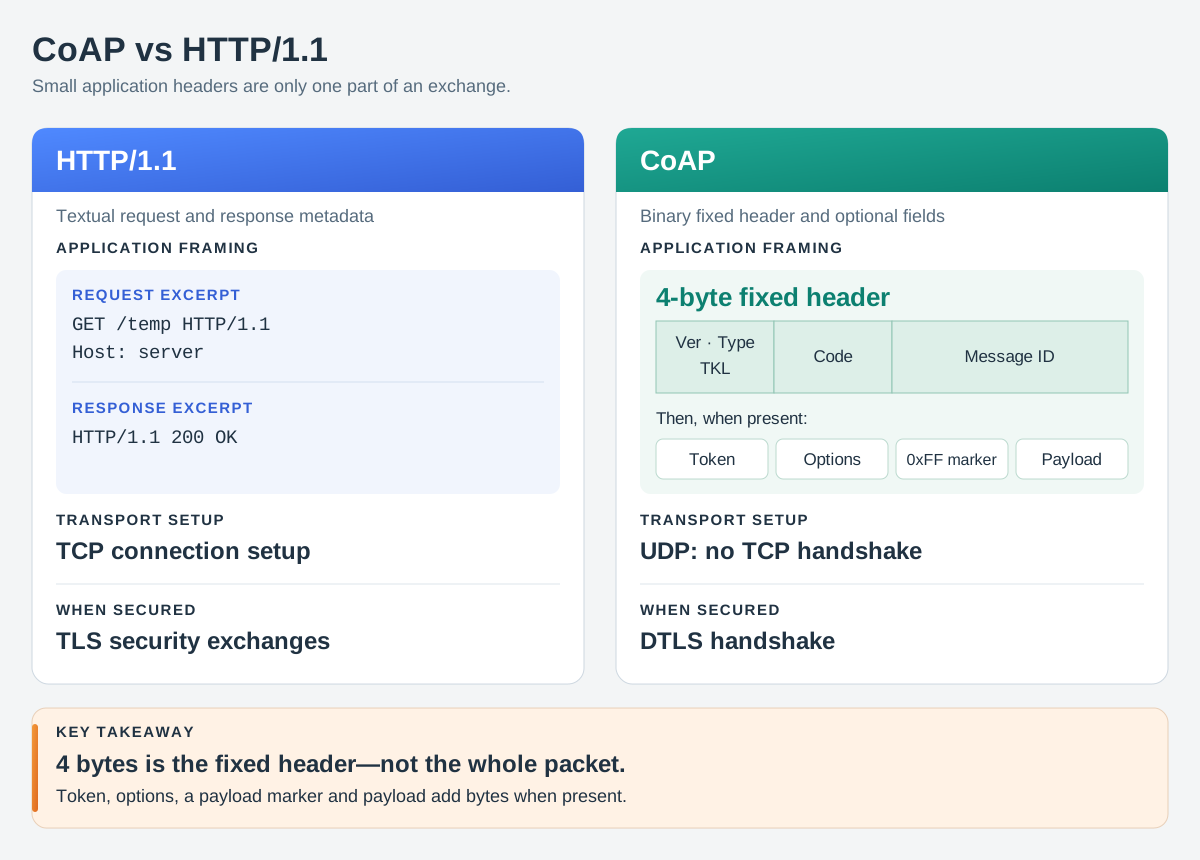
CoAP is a compact request and response protocol.
Broker Bex is your guide for this deck.
After studying this chapter
Learning objectives
You will be able to:
- Encode CoAP header fields and token length into message bytes.
- Match tokens and message IDs across replies and retries.
- Explain: CoAP is a compact request and response protocol.
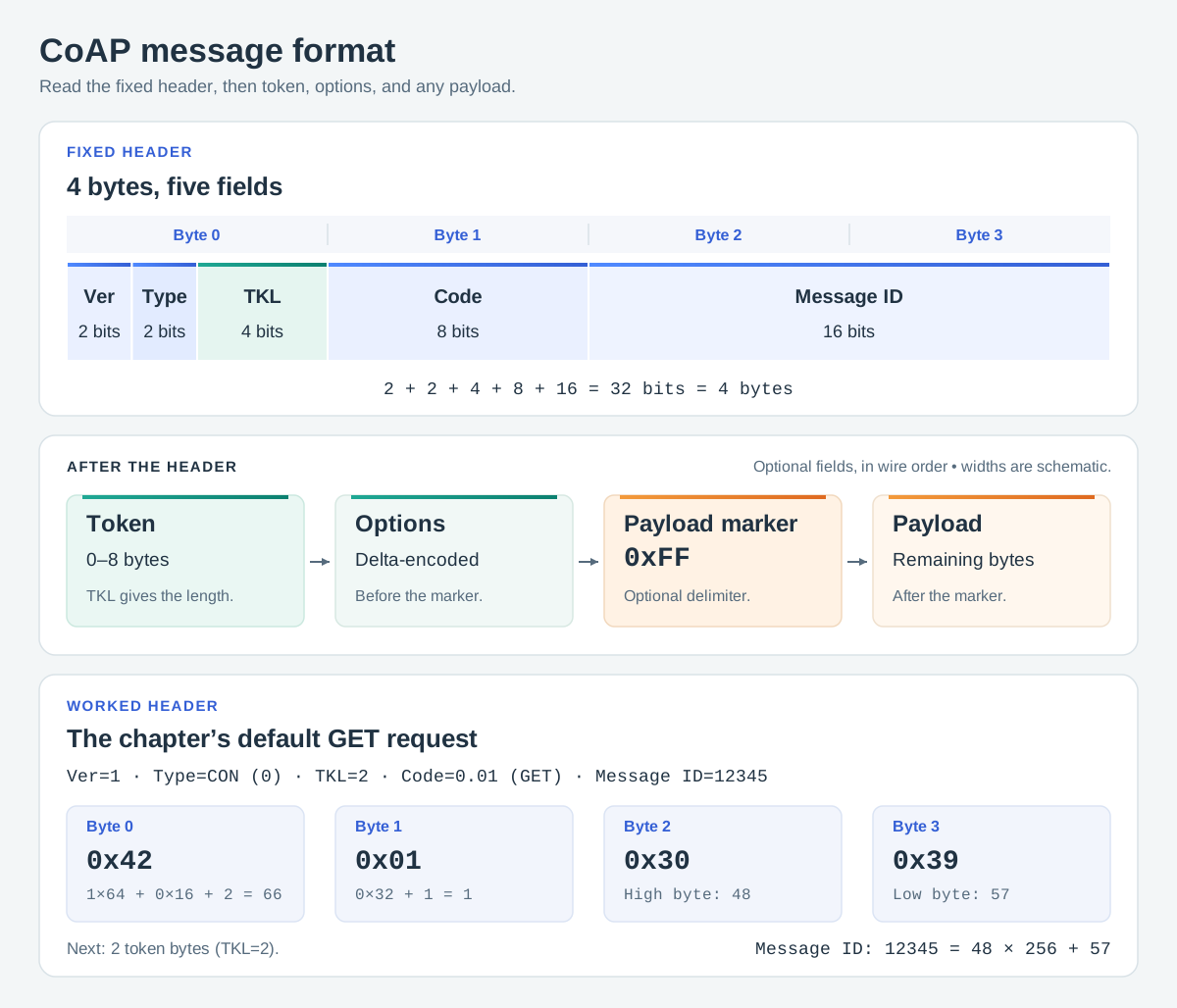
- Explain: Construct a CoAP message byte-by-byte and see exactly how the 4-byte header is encoded.
Major section
Start With the Decision
CoAP is a compact request and response protocol.
- A packet is one unit sent across a network.
- In a few bytes, a CoAP packet holds a type that says how to handle delivery.
- A token links a reply to its request; a code names the request or result; and an ID identifies the message.
Major section
Try It: CoAP Message Byte Builder
Construct a CoAP message byte-by-byte and see exactly how the 4-byte header is encoded.
- This helps you understand what the coap-simple library constructs behind the scenes when you call coap.get() or coap.put().
- In a Python terminal, send a CON GET for /temperature over UDP to a local CoAP responder; inspect the first four bytes before any option or payload.
- The real local request was 42 01 12 34 aa bb bb 74 65 6d 70 65 72 61 74 75 72 65: version 1, CON, token length 2, GET, and message ID 0x1234.
Major section
Visual: CoAP Message Structure
TKL then tells the decoder how many token bytes follow; delta-encoded options continue until the optional 0xFF payload marker, after which the remaining bytes are payload.
- That order is the lab's packet-decoding checklist.
Major section
Common Mistake: Misunderstanding CoAP Token vs Message ID Correlation
The Error: Developers new to CoAP often confuse Message ID (MID) and Token, attempting to match responses to requests using MID alone.
- This causes failures with Observe notifications and separate responses.
- Separate Responses: Server sends empty ACK (MID=12345) immediately, then data CON (MID=12346) later.
- Both share the same Token.
Major section
Common Mistake: Misunderstanding CoAP Token vs Message ID Correlation (continued)
Concurrent Requests: Client sends multiple requests simultaneously.
- Responses may arrive out-of-order.
- Token uniquely identifies which request each response answers.
- Illustrative failure: A client that discards Observe notifications with new Message IDs can lose readings.
- Correlate notifications by the observation Token; use Message ID for ACK and duplicate handling.
Deck summary
Key takeaways
CoAP is a compact request and response protocol.
- Construct a CoAP message byte-by-byte and see exactly how the 4-byte header is encoded.
- TKL then tells the decoder how many token bytes follow; delta-encoded options continue until the optional 0xFF payload marker, after which the remaining bytes are payload.
- The Error: Developers new to CoAP often confuse Message ID (MID) and Token, attempting to match responses to requests using MID alone.
- Concurrent Requests: Client sends multiple requests simultaneously.
Retrieval practice
Recall check 1 of 4

Broker Bex says: answer from memory, then check your reasoning.
Q1A CoAP server receives a POST request, creates a new sensor-reading resource at a new URI, and stores it successfully. Which response code should the server return?
Show answer
Answer: B see answers page
Retrieval practice
Recall check 2 of 4

Broker Bex says: answer from memory, then check your reasoning.
Q2Per this chapter's Common Pitfalls, why can using Confirmable (CON) messages for every CoAP request be risky on a lossy network?
Show answer
Answer: D CON waits for an ACK; with four retransmissions, failure detection can take 62–93 seconds under RFC 7252 defaults.
Retrieval practice
Recall check 3 of 4

Broker Bex says: answer from memory, then check your reasoning.
Q3What binds the server address, port and protocol context before CoAP resources receive requests?
Show answer
Answer: C The server binds an address, port, and protocol context before any URI can receive a request.
Retrieval practice
Recall check 4 of 4

Broker Bex says: answer from memory, then check your reasoning.
Q4This chapter's Advanced Lab Consolidation Notes recommend a hybrid CON/NON policy for a production-style CoAP deployment. Which message type does it recommend for routine telemetry versus for commands, safety alerts, firmware blocks, or configuration changes?
Show answer
Answer: A see answers page
Print reference
Answers 1 of 2
Answer key.
- B · 2.01 Created identifies the new resource produced by this POST. 2.04 Changed describes a successful change to an existing resource. 2.05 Content delivers a representation and can also answer a POST that does not create a new resource. Client errors (4.xx) indicate request problems.
- D · CON waits for an ACK; with four retransmissions, failure detection can take 62–93 seconds under RFC 7252 defaults.
- C · The server binds an address, port, and protocol context before any URI can receive a request.
Print reference
Answers 2 of 2
Answer key.
- A · The chapter's hybrid policy: NON for routine telemetry where the next value replaces the previous one, CON for user actions, safety alerts, firmware blocks, or configuration changes -- preserving UDP's energy benefit while still proving delivery for messages that cannot be silently lost.