Cellular IoT · Study deck
Practice: LTE-M Power Modes and Coverage
Picture a mobile medical case that reports temperature while travelling.
Radio Remi is your guide for this deck.
After studying this chapter
Learning objectives
You will be able to:
- Trace an LTE-M device from cell search through registration and packet-data readiness.
- Explain why LTE-M is often selected for mobile or more responsive IoT devices.
- Compare PSM and eDRX as design choices rather than fixed battery-life guarantees.
- Decide when a compact uplink should use a control-plane style path and when a user-plane data session is a better model.
Major section
Start With the Story
This opening does not predict every operator or battery.
- Its radio must wake, find service, send one small record, wait for any reply, and return to deep sleep.
- The field team must know whether the message arrives soon enough without draining the battery.
- Each state costs time and current, so the lab should make the trade-off visible.
Major section
Phoebe's Field Notes: Why a Moving Tracker Should Distrust a High-Gain Antenna
An 8 dBi patch reaches 31 dBm on-axis, but the Kraus estimate gives only an 80.9° symmetric beam.
- That pattern estimate is a route-test hypothesis, not an antenna certificate.
Major section
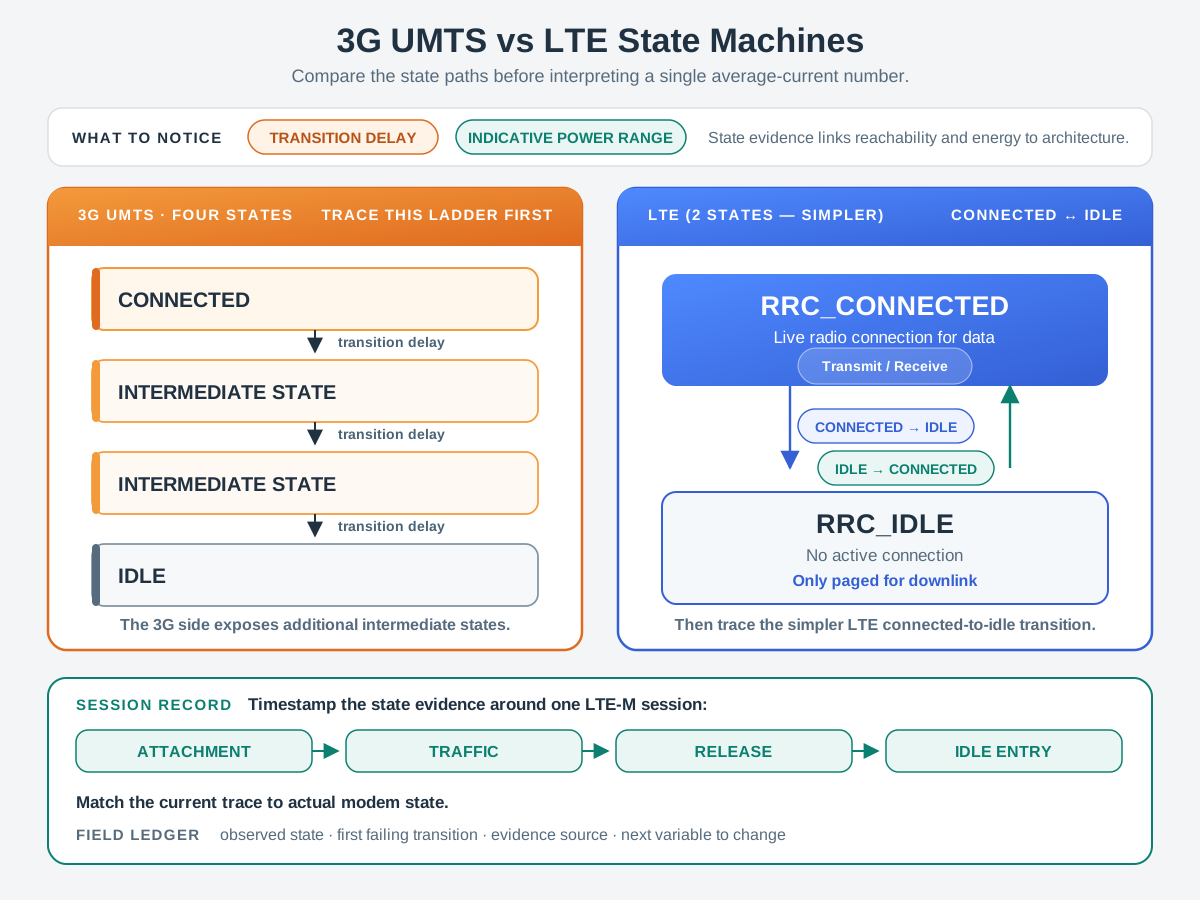
Overview: LTE-M Claims Need A Session Record
A live link passes through more states before idle.
- The delay and current bands show why a low sleep value cannot describe the full session.
- The field record adds times for attach, traffic, release, and idle entry.
- This reveals a slow release, a failed state change, or a sound sleep period.
Major section
Key Concepts
EPS bearer / packet data context: The network data session that gives the device an IP path through the LTE packet core.
- User-plane data: A normal IP data path that is better for larger payloads, frequent transfers, or longer sessions.
- PSM (Power Saving Mode): A deep sleep state that reduces energy use but makes the device unreachable until it wakes or performs a network update.
- Control-plane optimization: A method for small data where payloads can be carried with signaling to reduce setup overhead in supported deployments.
Major section
Experiment 4: Control Plane or User Plane
Payload path selection depends on message size, frequency, security needs, module support, and operator support.
- For each, enter payload bytes, deadline, retry count, whether a stale copy may be dropped, and the proposed control-plane or user-plane path.
- On your own modem and subscription, send one tagged payload by each supported path and match its payload ID to a server receipt.
- No control-plane or user-plane cellular transfer was run in this lane; the classification is a design exercise until these on-hardware receipts exist.
Deck summary
Key takeaways
This opening does not predict every operator or battery.
- An 8 dBi patch reaches 31 dBm on-axis, but the Kraus estimate gives only an 80.9° symmetric beam.
- A live link passes through more states before idle.
- EPS bearer / packet data context: The network data session that gives the device an IP path through the LTE packet core.
- Payload path selection depends on message size, frequency, security needs, module support, and operator support.
Retrieval practice
Recall check 1 of 3

Radio Remi says: answer from memory, then check your reasoning.
Q1An LTE-M lab shows a modem attaching and sending one payload. What record should the team build before treating that result as deployment evidence?
Show answer
Answer: C LTE-M lab approval should connect attach evidence, RRC and packet-context state, SIM or eSIM identity, power-mode timing, payload success, mobility condition, and measured current before the result is used beyond the bench.
Retrieval practice
Recall check 2 of 3
Radio Remi says: answer from memory, then check your reasoning.
Q2A tracker moves between cities and must report route exceptions while it is in motion. Why is LTE-M a defensible first technology to test?
Show answer
Answer: D LTE-M is usually tested first for mobile or more responsive devices, but real behavior must be measured with the intended hardware, SIM profile, antenna, operator, and power mode.
Retrieval practice
Recall check 3 of 3
Radio Remi says: answer from memory, then check your reasoning.
Q3Complete the state transition helper for the LTE-M lab model:
Show answer
Answer: A The helper follows the lab model: search leads to registration, registration leads to data readiness, compact payloads can use a compact path where supported, and larger payloads use a normal data session.
Print reference
Answers 1 of 2
Answer key.
- C · LTE-M lab approval should connect attach evidence, RRC and packet-context state, SIM or eSIM identity, power-mode timing, payload success, mobility condition, and measured current before the result is used beyond the bench.
- D · LTE-M is usually tested first for mobile or more responsive devices, but real behavior must be measured with the intended hardware, SIM profile, antenna, operator, and power mode.
Print reference
Answers 2 of 2
Answer key.
- A · The helper follows the lab model: search leads to registration, registration leads to data readiness, compact payloads can use a compact path where supported, and larger payloads use a normal data session.